

Anti-aging face care ingredients: proven roles and effects
TL;DR:
- Anti-aging actives target specific mechanisms of skin aging.
- Clinical results show wrinkle reductions of up to 36% in 8 weeks.
- Consistency and a tailored routine are essential for visible results.
Hyaluronic acid can reduce wrinkles by 36% in just a few weeks. Yet, many people buy anti-aging skincare without really knowing what it contains or why some actives work better than others. The result: products piling up on the shelf, disappointed expectations, and skin that doesn't really change. This guide explains concretely what anti-aging actives are, what clinical studies prove about their effectiveness, how to combine them intelligently, and how to incorporate them into a face routine that delivers real results. No vague promises: facts, figures, and advice you can apply starting tonight.
Table of Contents
- Understanding Anti-Aging Actives: Key Definitions and Functions
- Clinical Evidence: Measured Effectiveness of Key Actives
- Precautions, Synergies, and Usage Tips
- Incorporating Anti-Aging Actives into an Effective Face Routine
- Our Perspective: What Most People Forget About Anti-Aging Actives
- Accelerate Your Results with an Expert Routine
- Frequently Asked Questions About Anti-Aging Actives
Key Points
| Point | Details |
|---|---|
| Clinical Evidence | Actives such as retinol, vitamin C, and hyaluronic acid show measurable effects in 4 to 12 weeks. |
| Beneficial Synergies | Judiciously combining different actives optimizes anti-aging results without causing irritation. |
| Essential Precautions | Following the correct dosages, contraindications, and gradual introduction ensures an effective and safe routine. |
| Tailored Routine | Adapting your choice of actives to your skin type and goals maximizes anti-aging benefits. |
Understanding Anti-Aging Actives: Key Definitions and Functions
An anti-aging active is a substance with a specific role: to prevent, slow down, or correct the visible signs of skin aging. Wrinkles, loss of firmness, dull complexion, uneven texture. It is not a fragrance or a texturizing agent. It is the ingredient that really does the work in your skincare.
Skin ages for several biological reasons: collagen production decreases starting at age 25, cells renew more slowly, and external aggressors such as the sun or pollution accelerate this process. Anti-aging actives act directly on these mechanisms.
Here are the main actives to know and their functions:
- Hyaluronic Acid (HA): a molecule naturally present in the skin, it deeply hydrates and improves elasticity. It attracts and retains water in the tissues, visibly plumping the skin.
- Retinol: a derivative of vitamin A, it is one of the most studied actives. It accelerates cell renewal, stimulates collagen production, and reduces dark spots.
- Vitamin C: a powerful antioxidant, it protects the skin from free radicals, evens out the complexion, and contributes to collagen synthesis.
- Peptides: small chains of amino acids that send signals to cells to produce more collagen and structural proteins.
- Antioxidants: a varied group (resveratrol, niacinamide, tocopherol) whose role of antioxidants is to neutralize the free radicals responsible for premature aging.
Each active targets a different mechanism. Hyaluronic acid works on hydration and volume. Retinol works deep down on cell structure. Vitamin C protects and brightens. Peptides stimulate regeneration. Understanding these distinctions is the first step to choosing what your skin really needs, rather than what advertising suggests you buy.
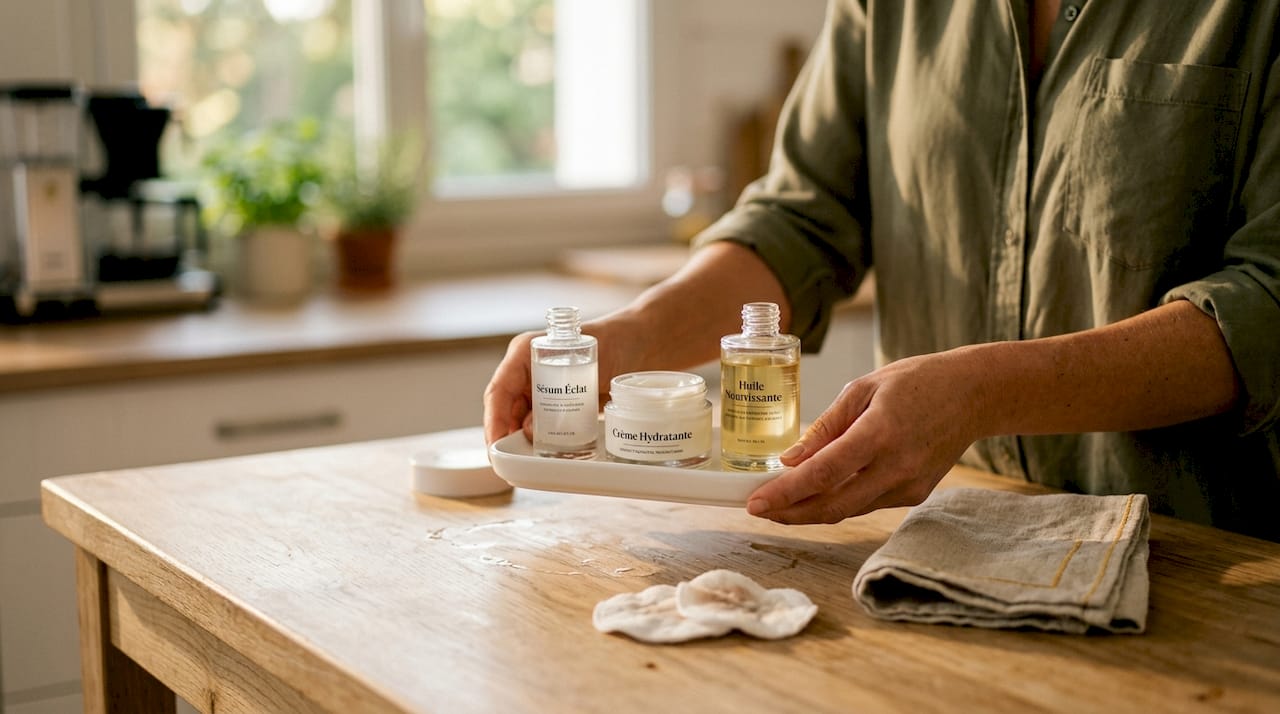
It is also important to note that the concentration of an active in a formula matters as much as its presence. A product that lists retinol at the end of the INCI (the list of ingredients) contains so little that it will produce no measurable effect. Read the labels carefully.
Clinical Evidence: Measured Effectiveness of Key Actives
Clinical studies provide concrete figures. And these figures change the way we look at our morning skincare. Here is what science has measured on the most used actives.
Results vary depending on the active, concentration, and duration of use. But the trends are clear: 20% less roughness with retinol, 18% more firmness with peptides and vitamin C, 36% fewer wrinkles with hyaluronic acid. These figures come from studies on 4 to 12 weeks of regular application.
| Active | Main Effect | Measured Result | Average Time |
|---|---|---|---|
| Hyaluronic Acid | Hydration, Volume | Wrinkles Reduced by 36% | 4 to 8 Weeks |
| Retinol | Cell Renewal | Roughness Reduced by 20% | 8 to 12 Weeks |
| Peptides | Collagen Stimulation | Firmness Increased by 18% | 6 to 10 Weeks |
| Vitamin C | Protection, Radiance | Firmness Increased by 18% | 4 to 8 Weeks |
To Remember: These results assume daily, regular application, with an effective concentration. A product used twice a week will not give the same results as daily application.
This data is valuable for structuring an effective anti-aging routine at home. It also allows you to set realistic expectations: you will not see a transformation in three days, but in eight weeks of serious application, the results are measurable.
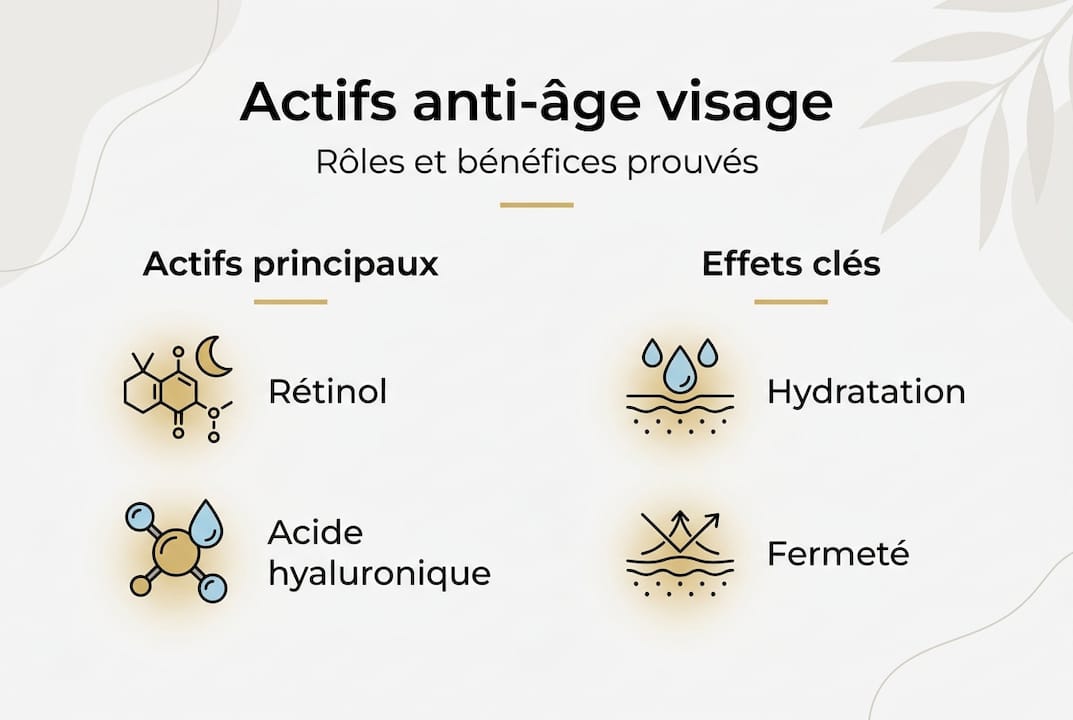
There are several types of face care that incorporate these actives: serums, creams, oils, masks. The serum remains the most concentrated format and therefore the most effective for delivering actives deep down. If you want to learn more about how to do anti-aging skincare at home, the application protocols make all the difference in the final results.
One important clarification: studies often compare isolated actives. In practice, formulas combine several actives, which can amplify or sometimes attenuate the effects depending on the combinations chosen.
Precautions, Synergies, and Usage Tips
Knowing the effectiveness of an active is not enough. You also need to know how to use it safely, and how to take advantage of the right combinations.
Retinol is the active that requires the most precautions. It can cause a retinization period: redness, slight peeling, increased sensitivity during the first few weeks. Bakuchiol is a natural alternative for sensitive skin or pregnant women, with similar effects but much better tolerance.
Actives to avoid or use with caution:
- Retinol: not recommended during pregnancy, introduce gradually (1 to 2 times a week at first)
- Vitamin C: can sting on reactive skin, better tolerated in the morning
- Exfoliating Acids (AHA/BHA): do not combine with retinol on the same evening
- High-Dose Niacinamide: can reduce the effectiveness of vitamin C if applied simultaneously
However, the most effective synergies are worth knowing. The combination of hyaluronic acid and retinol is particularly powerful: HA hydrates and strengthens the skin barrier, which limits retinol irritation while amplifying its effects. The Q10 Collagen and Retinol Night is an example of a formula that exploits this type of synergy.
To build a solid personalized beauty routine, start with a single active, observe your skin's reaction for two to three weeks, then add gradually. There is no need to stack everything from the start.
Pro tip: Apply retinol only in the evening, on dry skin, and always finish with a moisturizer. In the morning, adding antioxidants like vitamin C before your SPF protects the skin from the day's aggressors. This morning/evening combination is the basis of an effective anti-aging beauty checklist.
Incorporating Anti-Aging Actives into an Effective Face Routine
Knowing what actives do is good. Knowing how to place them in a coherent routine is what makes the difference between a visible result and skin that stagnates.
Here is a typical morning/evening routine for mature skin or skin that is starting to show signs of aging:
- Morning: gentle cleansing with a gel or foam without harsh sulfates
- Morning: vitamin C serum applied to slightly damp skin for better absorption
- Morning: moisturizer with hyaluronic acid to seal in hydration
- Morning: SPF 30 minimum to protect the work of the actives (without sun protection, retinol and vitamin C lose a large part of their effectiveness)
- Evening: double cleansing if you wear makeup or sunscreen
- Evening: retinol serum or cream two to three times a week at first, then daily if the skin tolerates it well
- Evening: rich cream to nourish and support the skin barrier during the night
For sensitive skin, replace retinol with bakuchiol and reduce vitamin C to an application every two days. For combination skin, favor light gel textures. For very mature skin, a high-end routine with higher concentrations can accelerate results.
The synergies between actives, especially HA and retinol, give visible results in 4 weeks for some actives, provided there is regular application. The key is consistency, not complexity.
Pro tip: If you don't know where to start, choosing the skincare adapted to your skin type before choosing your actives is a step that is often overlooked but decisive. A perfect active on the wrong skin remains poorly performing.
Our Perspective: What Most People Forget About Anti-Aging Actives
The anti-aging skincare market constantly pushes towards novelty: the new miracle active, the revolutionary formula, the 200-euro serum. But after studying hundreds of formulas and following real results, our conviction is simple: consistency always beats sophistication.
A simple routine with three well-chosen actives, applied every day for three months, will give better results than a collection of ten products used irregularly. It is uncomfortable to hear because it doesn't sell a dream. But it is the reality.
The other truth often eluded: without a diagnosis adapted to your skin, even the best active remains poorly performing. The forgotten role of antioxidants is a good example: many ignore them in favor of retinol, while they constitute the first line of defense against premature aging.
Finally, the pleasure of use really matters. If your skincare smells bad, sticks, or irritates, you will abandon it. And zero results guaranteed.
Accelerate Your Results with an Expert Routine
You now have the basics to understand, choose, and combine anti-aging actives intelligently. The next step is to take action with formulas that have proven themselves.

At HBPS-Beauty, we have selected clinically validated products to meet the real needs of skin seeking to slow down aging. The MultiBeauty Pharmanex combines complementary actives in a formula designed for synergy. The Q10 Collagen & Retinol Night works while you sleep to regenerate and firm. Take the time to explore the entire HBPS-Beauty range to find the routine that exactly matches your skin and your goals.
Frequently Asked Questions About Anti-Aging Actives
What are the most effective anti-aging actives for the face?
Clinical studies on these actives recommend hyaluronic acid, retinol, vitamin C, and peptides as references for smoothing, firming, and deeply hydrating the skin.
Can you combine several anti-aging actives in your face routine?
Yes, combining HA and retinol is particularly recommended to amplify the effects; just make sure to introduce each active gradually and respect your skin's tolerance.
What actives to avoid during pregnancy or on sensitive skin?
Retinol is to be avoided during pregnancy; bakuchiol for sensitive skin or pregnant women offers similar effects with much better tolerance.
After how long do anti-aging actives work on the skin?
Visible results in 4 to 12 weeks depending on the active used, provided there is regular and daily application.
Recommendation
- Anti-wrinkle face routine at home: complete guide – HBPS-Beauty
- Antioxidants: their essential role in beauty (2026 guide) – HBPS Beauty & Fashion
- Maximizing the Benefits of Natural Actives in Cosmetics in 2026 – HBPS Beauty & Fashion
- Facial Massage: +127% Blood Flow for Radiant Skin – HBPS Beauty & Fashion
- Best practices for skin care: proven anti-aging methods
- Astaxanthin in Skincare: The Ultimate Antioxidant for Youthful, Radiant Skin – ZenChemy Lab