

Benefits of Home Care: Complete 2026 Guide
TL;DR:
- Home care provides comprehensive support, improving patients' health, independence, and well-being.
- It helps reduce complications, maintain social connections, and improve quality of life in a familiar environment.
Home care refers to the range of medical, paramedical, and wellness services provided directly at the patient's home, as an alternative to or supplement for traditional hospitalization. The benefits of home care are now recognized by healthcare professionals: better continuity of care, reduced infections, maintained independence, and psychological support. In France, services such as SSIAD (Home Nursing Care Services) and HAD (Home-Based Hospitalization) structure this offering, while financial assistance such as the APA (Personalized Autonomy Allowance) makes it easier to access. Remote monitoring and professional beauty devices now complete this landscape, providing comprehensive support.
What are the main medical and psychosocial benefits of home care?
Home medical monitoring reduces readmissions related to domestic accidents by 30% thanks to specific protocols. This figure reflects a concrete reality: a patient monitored at home benefits from continuous attention and early detection of warning signs, which the hospital cannot guarantee after discharge.
Hospitalized patients have a complication rate 12% higher than those monitored at home after more than three days of hospitalization. Nosocomial infections, falls in unfamiliar environments, and disorientation related to a change of environment largely explain this gap.
Psychosocially, staying in a familiar environment improves morale, promotes better sleep, and reduces stress. The presence of loved ones, regular meals, and everyday objects directly contribute to treatment adherence and the prevention of dependency.
The psychosocial benefits of home medical care include:
- Maintenance of social connections: family members remain involved without the constraints of hospital visiting hours.
- Reduced anxiety: the familiar environment reduces the fear and isolation often felt in a facility.
- Better treatment adherence: the patient feels involved in their recovery, which strengthens their commitment to the treatment.
- Reduced caregiver burden: professionals working at home train and support loved ones, reducing their exhaustion.
Pro tip: Ask the nurse or coordinating physician to establish a written protocol of warning signs to monitor. This simple document prevents unnecessary emergency hospitalizations and reassures the whole family.
How does home care promote independence and quality of life?
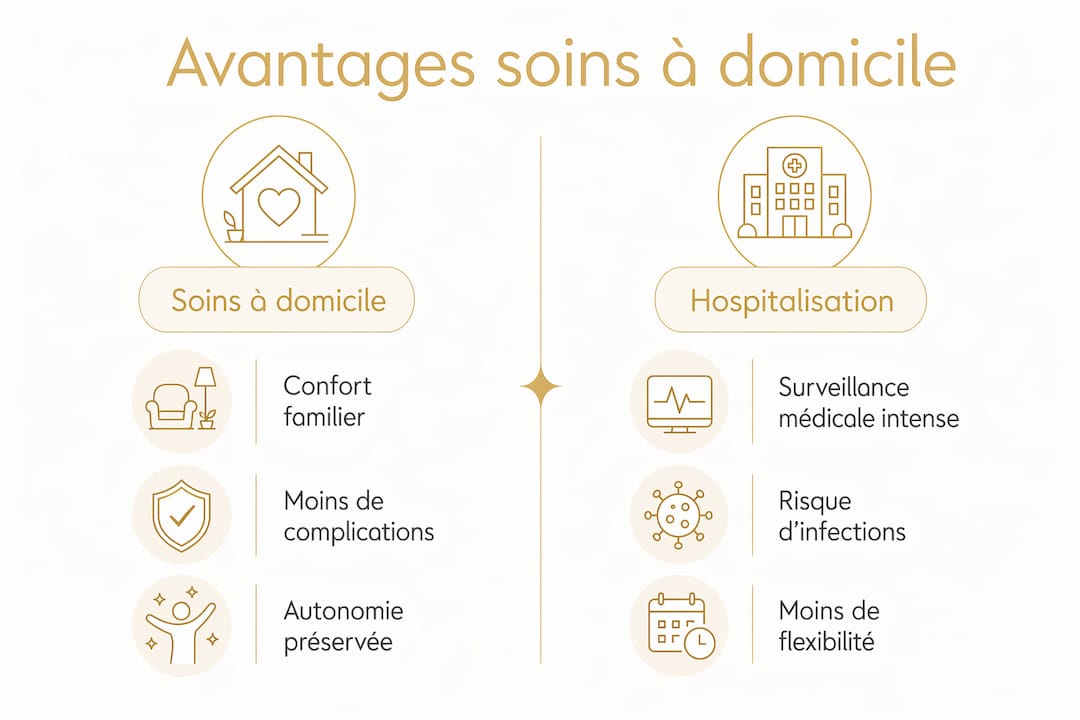
Choosing home care restores independence and the patient's sense of control, two essential factors in the healing process. Keeping your own schedule, choosing your meals, and maintaining your daily routines is no minor detail: it is a direct therapeutic lever for self-esteem and motivation to recover.

The flexibility of home care for older adults allows interventions to be adapted to each person's actual pace of life. A home health aide who comes in the morning for personal care, a physical therapist in the late morning, and a nurse in the evening for medication: this schedule respects habits without imposing the collective pace of a facility.
Pro tip: Before setting up home care, conduct an environmental assessment with an occupational therapist. Adapting the home, installing grab bars, improving lighting, or removing slippery rugs creates a safe space and reduces the risk of falls.
The table below compares the two types of care based on the criteria that matter most for quality of life:
| Criterion | Home care | Traditional hospitalization |
|---|---|---|
| Environment | Familiar, personalized | Standardized, collective |
| Independence | Preserved and encouraged | Limited by protocols |
| Presence of loved ones | Continuous, unrestricted | Subject to visiting hours |
| Infection risk | Low | High (nosocomial infections) |
| Cost to the patient | Variable depending on assistance | Often higher without coverage |
| Personalized follow-up | Adapted to habits | Uniform for all patients |
What are the different types of home care, and how do they work?
Multidisciplinary healthcare professionals work at home under coordination and medical prescription, covering medical, paramedical, and beauty services. This network organization guarantees comprehensive care without disruption between the different providers.
The main types of services available at home are:
- SSIAD (Home Nursing Care Services): technical and hygiene care, fully funded by the National Health Insurance, with no advance payment required. Access requires a medical prescription and is available to people aged 60 and over.
- HAD (Home-Based Hospitalization): care for complex conditions normally reserved for the hospital, such as IV treatments, palliative care, or intensive rehabilitation.
- Home aides: assistance with activities of daily living (meals, cleaning, shopping), often coordinated with medical care.
- Home palliative care: end-of-life support in a humane and familiar setting, with psychological support for the patient and their loved ones.
- Home beauty care: manicures, pedicures, facial and hair care, performed by specialized beauty therapists or using adapted professional devices. These services, like those offered by professionals specializing in personalized beauty care, play a real role in the overall well-being of people with reduced mobility.
Coordination between these providers is based on a care plan established by the attending physician, often in conjunction with a medical-social team. This plan defines the frequency of interventions, therapeutic objectives, and emergency contacts.
What financial assistance makes home care easier to access?
Access to home care is supported by several public programs that significantly reduce the out-of-pocket costs for families. Here are the key steps to benefit from them:
-
Assess the level of dependency (GIR): a medical-social team from the Departmental Council assesses the loss of independence according to the AGGIR scale, from GIR 1 (total dependency) to GIR 4 (partial dependency). The GIR level determines the amount of assistance granted.
-
Apply for the APA (Personalized Autonomy Allowance): the APA helps people aged 60 and over who have lost independence to fund part of their home care. As of January 1, 2026, beneficiaries with resources exceeding €933.89 will still owe a personal contribution.
-
Identify the covered services: the APA for home care covers home assistance, medical equipment, meal delivery, teleassistance, and home adaptation work. This list is broader than many families imagine.
-
Contact SSIADs through the attending physician: a simple medical prescription is enough to access SSIADs, which are 100% covered by the National Health Insurance. No advance payment is required from the user.
-
Contact the CCAS (Municipal Social Action Center): every municipality has a CCAS that can direct you to complementary local assistance, especially for people who are not eligible for the APA or are awaiting a decision.
Hiring a home aide directly involves employer obligations that families sometimes underestimate, particularly URSSAF declarations and leave management. Using an approved agency or service provider simplifies these administrative procedures.
How to incorporate beauty and wellness care at home for a comprehensive effect?
Home beauty care is not an optional luxury. It improves morale and comfort, and strengthens the confidence of beneficiaries, especially seniors or people with reduced mobility. A facial treatment performed at home, a hair care session, or an adapted anti-aging routine produces measurable effects on psychological well-being.
The benefits of home beauty care include:
- Adapted professional devices: devices such as those from the Nu Skin or GESKE brands, available on Hbps-beauty, achieve 60% to 70% of the effectiveness of an in-salon treatment. This level of performance is sufficient for visible results on the skin and hair.
- Personalized routine: unlike a salon, home care allows each treatment to be adapted to the person's pace, physical constraints, and preferences. An effective beauty routine can be built in a few simple steps, without fatigue or travel.
- Impact on senior morale: field studies show that older adults who have access to regular home beauty care report a significantly greater sense of dignity and well-being. This factor is often overlooked in traditional care plans.
- Complementarity with medical care: a moisturizing treatment or hair massage after a physical therapy session strengthens the overall effect of the care. Body and mind progress together.
To learn more, the benefits of home skincare document precisely how a structured routine improves skin condition and morale in the long term.
Key Points
Home care is the most comprehensive solution for combining medical safety, personal independence, and overall well-being without leaving your familiar environment.
| Point | Details |
|---|---|
| Reduced complications | Home monitoring reduces readmissions by 30% and decreases the complication rate by 12%. |
| Preserved independence | The patient maintains their habits, pace, and sense of control, which are key factors in recovery. |
| Accessible financial assistance | The APA and SSIADs cover a large part of the costs for people aged 60 and over. |
| Coordinated multidisciplinary care | Nurses, physical therapists, home aides, and beauty therapists work according to a personalized plan. |
| Included beauty well-being | Home beauty care strengthens self-confidence and effectively complements medical care. |
What I learned by observing the evolution of home care
Most articles on this topic present home care as an alternative to the hospital. This is a framing error. The real strength of home care is its complementarity with the hospital, not its opposition to it. A patient who leaves surgery and returns home with a well-coordinated SSIAD protocol recovers better than a patient kept in a facility due to a lack of organization.
What strikes me is that the home medical-social sector still lacks public funding to meet growing demand. Families who navigate administrative procedures alone lose valuable time that the system should spare them.
The other underestimated angle: home beauty care. It is treated as an optional supplement when it directly impacts dignity, self-esteem, and motivation to seek treatment. An older person who feels good about their appearance is more involved in their medical treatment. This link between beauty and health deserves to be integrated from the design of care plans, not added as an option.
— JSCC
Hbps-beauty supports your well-being at home
Hbps-beauty offers a selection of products and devices designed to complement your home care in terms of beauty and well-being. Brands such as Nu Skin, GESKE, and Eternas are available, with advice tailored to each profile.
The Beauty Focus MultiBeauty Pharmanex is a concrete example of a solution that naturally integrates into a home care routine. Designed to nourish the skin from within and support a radiant complexion, it complements topical treatments without the need to travel. Discover the entire range on Hbps-beauty to build a beauty routine adapted to your needs and pace of life.
FAQ
What exactly is home care?
Home care refers to all medical, paramedical, and wellness services provided at the patient's home, including nursing care via SSIADs, HAD, home aides, and personalized beauty care.
Why choose home care instead of hospitalization?
Home care reduces the complication rate by 12% compared to traditional hospitalization and decreases readmissions by 30%, while preserving the patient's independence and comfort in their familiar environment.
Is home care for older adults covered?
SSIADs are 100% covered by the National Health Insurance with a medical prescription, and the APA covers a large part of other services for people aged 60 and over, depending on their level of dependency (GIR).
Are home beauty devices really effective?
Professional beauty devices used at home achieve 60 to 70% of the effectiveness of a treatment carried out in a salon, which is sufficient to obtain visible results on the skin and hair with regular use.
How to start home care?
Start by consulting your doctor to obtain a suitable prescription, then contact the CCAS of your municipality and the Departmental Council to assess your eligibility for APA and identify the SSIAD services available in your area.