

Clean Beauty: Why This Concept Is Changing Our Skincare
Finding a truly clean beauty product can quickly become a headache in the face of contradictory promises and incomprehensible ingredient lists. This topic directly concerns those who want a healthy skincare routine without compromising their skin or the environment. Discover how the avoidance of irritating and allergenic ingredients as well as total transparency can transform your beauty choices and help you weed out misconceptions.
Table of Contents
- Definition of clean beauty and misconceptions
- Key criteria of a clean beauty product
- Main labels and lack of legal framework
- Benefits for health and the environment
- Greenwashing and mistakes to avoid
Key Takeaways
| Point | Details |
|---|---|
| Definition of clean beauty | Clean beauty goes beyond a simple label; it is a response to the regulatory gaps in the cosmetics industry. |
| Importance of transparent labeling | Clean products must have a clear and readable ingredient list, excluding harmful substances. |
| Vigilance against greenwashing | Consumers must be wary of vague claims and check the legitimacy of labels to avoid greenwashing. |
| Benefits for health and the environment | Opting for clean products promotes healthier skin and reduces environmental impact. |
Definition of clean beauty and misconceptions
Clean beauty is not simply a marketing label or a fleeting trend. It is a concrete reaction to regulatory gaps in the global cosmetics industry.
The movement was born from a legitimate frustration: consumers discover that some ingredients used in skincare products remain insufficiently regulated. This concept focuses on the avoidance of irritating, allergenic, potential endocrine disruptors, and potentially carcinogenic substances.
But here is the catch: every promoter, every brand, defines its own list of "unhealthy" ingredients. There is no universal, standardized definition of clean beauty.
What clean beauty really means
This movement is part of a broader approach that incorporates ethical, cultural, and aesthetic dimensions. Clean beauty challenges traditional standards and seeks a more respectful approach to the body and the environment.
You find products labeled "clean" because they:
- Exclude certain families of substances deemed questionable
- Prioritize a transparent and readable composition
- Respect environmental or ethical standards
- Offer an alternative to highly synthetic formulas
Clean beauty reflects your right to know exactly what you apply to your skin.
The most widespread misconceptions
Misconception #1: "Clean" = safer
This is false. A "natural" ingredient or one absent from the clean list is not automatically risk-free. The dose makes the poison: even natural substances can irritate or cause allergic reactions. Cosmetics regulation shows that safety does not always equal "clean".
Misconception #2: All clean products are risk-free
The reality is more nuanced. A well-formulated clean product can be excellent, but a "conventional" product will not necessarily be dangerous. It all depends on your skin, your sensitivity, and the concentration of the ingredients.
Misconception #3: Clean necessarily means expensive
False. Affordable products display a respectful composition, while some premium brands play on marketing. Price does not determine quality or purity.
What this changes for your skincare
Choosing a clean approach means taking the time to read labels. It also means accepting that "clean" is a personal philosophy, not a rigorous scientific label.
This philosophy encourages transparency. Brands that adopt this approach generally publish their ingredients without beating around the bush. You know exactly what you are buying.
When you invest in products, this clarity helps build a lasting relationship of trust with the brands you choose.
Pro tip: Check the source ingredients with a tool like EWG Skin Deep, then test on a small area before incorporating a new product into your routine. Individual reactions vary greatly.
Key criteria of a clean beauty product
A clean beauty product does not exist by chance. It meets specific and verifiable criteria that you can learn to recognize.
For a product to be truly clean, it must first be a formula intended for application on the skin, respecting safety standards. But beyond this basic definition, several elements distinguish a real clean product from marketing imposters.
The essential criteria
A clean beauty product is recognized by several key points:
Here is an overview of the main criteria that differentiate a clean beauty product from a conventional product:
| Criterion | Clean beauty | Conventional product |
|---|---|---|
| Labeling transparency | Simplified ingredient list | Complex ingredient list |
| Ingredient sources | Mostly natural or of natural origin | Common synthetic and petrochemical |
| Toxicological control | Thorough evaluations of each ingredient | Sometimes limited or incomplete controls |
| Environmental standards | Environmentally friendly manufacturing | Few constraints on ecological footprint |
- Absence of banned substances: no components deemed harmful to health or the environment
- Transparent composition: labeling must be honest and readable, without jargon that hides the reality
- Complete toxicological evaluation: each ingredient has been tested and validated
- Formulation without major irritants: avoids harsh synthetic fragrances, questionable preservatives
- Absence of endocrine disruptors: a criterion that has become fundamental for clean beauty
A real clean product allows you to understand its composition without having to translate complex chemical names.
The ingredients that make the difference
Natural certification criteria establish that ingredients must be natural or of natural origin in the majority. This means you find more substances derived from plants, minerals, or biological processes.
But beware: natural does not automatically equal clean. A clean product also limits synthetic chemical preservatives to the strict necessity. Manufacturing processes must be ecological and ethical.
Transparent labeling, your best ally
The composition of cosmetic products must comply with official standards and be clearly displayed. In France and Europe, this obligation guarantees your right to know what you put on your skin.
Always read the INCI list (International Nomenclature of Cosmetic Ingredients). Ingredients are listed in descending order of concentration. A clean product generally displays fewer than 15 to 20 ingredients, compared to 30 or 40 for conventional formulas.
Also check for the absence of these suspicious keywords: parabens, phthalates, benzene, formaldehyde, triclosan.
The certifications that matter
Some labels offer an independent verification of these criteria. The NATRUE label notably imposes strict standards regarding natural ingredients, the absence of polluting synthetic substances, and overall sustainability.
But not all good clean products are certified. Some small brands strictly respect these criteria without paying for a formal certification.
Pro tip: Start by checking the INCI list on each product, then compare with your known sensitivities. Note the ingredients that cause you problems and search for them on the EWG website to understand their safety score.
Main labels and lack of legal framework
Here is the uncomfortable reality: there is no universal legal framework that precisely defines what clean beauty is. This absence creates a void that private labels try to fill, with uneven results.
This situation means that each brand can claim to be "clean" without respecting the same criteria. Some labels rely on rigorous standards, others on simple self-declarations.
The reliable labels to know
Not all labels are equal. Here are those that offer a real guarantee:
Here is a quick comparison of the labels that offer a real level of guarantee for clean beauty:
| Recognized label | Strengths | Limitations |
|---|---|---|
| Ecocert | Strict organic certification, ecological requirements | Little control over packaging |
| NATRUE | Strict standards for ingredients and sustainability | High cost of obtaining for small brands |
| COSMOS | Independent control, rigorous specifications | Criteria sometimes variable by country |
| European Ecolabel | Official EU recognition, verifiable requirements | Covers few beauty products |
- European Ecolabel: one of the few official labels recognized in the European Union, with verifiable requirements
- NATRUE: imposes strict standards on natural ingredients and sustainability
- Cosmos: certifies organic and natural cosmetics according to rigorous specifications
- Ecocert: guarantees organic ingredients and validated ecological processes
- Cruelty-Free: certifies the absence of animal testing
The best labels offer an independent third-party certification, not just a brand self-declaration.
The problem with private labels
Many so-called clean or natural beauty labels remain entirely private. They do not always rely on rigorous specifications or independent third-party verification.
This situation means that some brands can create their own labels or join organizations with low requirements. You must remain vigilant in the face of these unverified marketing promises.
The absence of a homogeneous legal framework
The lack of strict regulation accentuates disparities. The absence of a homogeneous legal framework means that consumers lack a single, reliable reference to evaluate clean products.
In France and Europe, certain laws regulate cosmetics (forbidden composition, safety), but none impose the precise definition of "clean". This is why two products labeled clean can have very different compositions.
How to navigate this confusion
In the face of this blur, adopt a simple strategy:
- Prefer official labels or those certified by a third party
- Always check the INCI list, regardless of the displayed label
- Consult the reviews of independent testing organizations (EWG, for example)
- Beware of labels that are too generic or self-declared
The big brands on HBPS-Beauty often offer certified products, but check the source of their labels.
Pro tip: Look for the logos of recognized labels (Ecocert, NATRUE, European Ecolabel) directly on the packaging, and check their authenticity on the official label website before buying.
Benefits for health and the environment
Choosing clean beauty is not a simple trend. It is a decision that impacts your health and that of the planet.
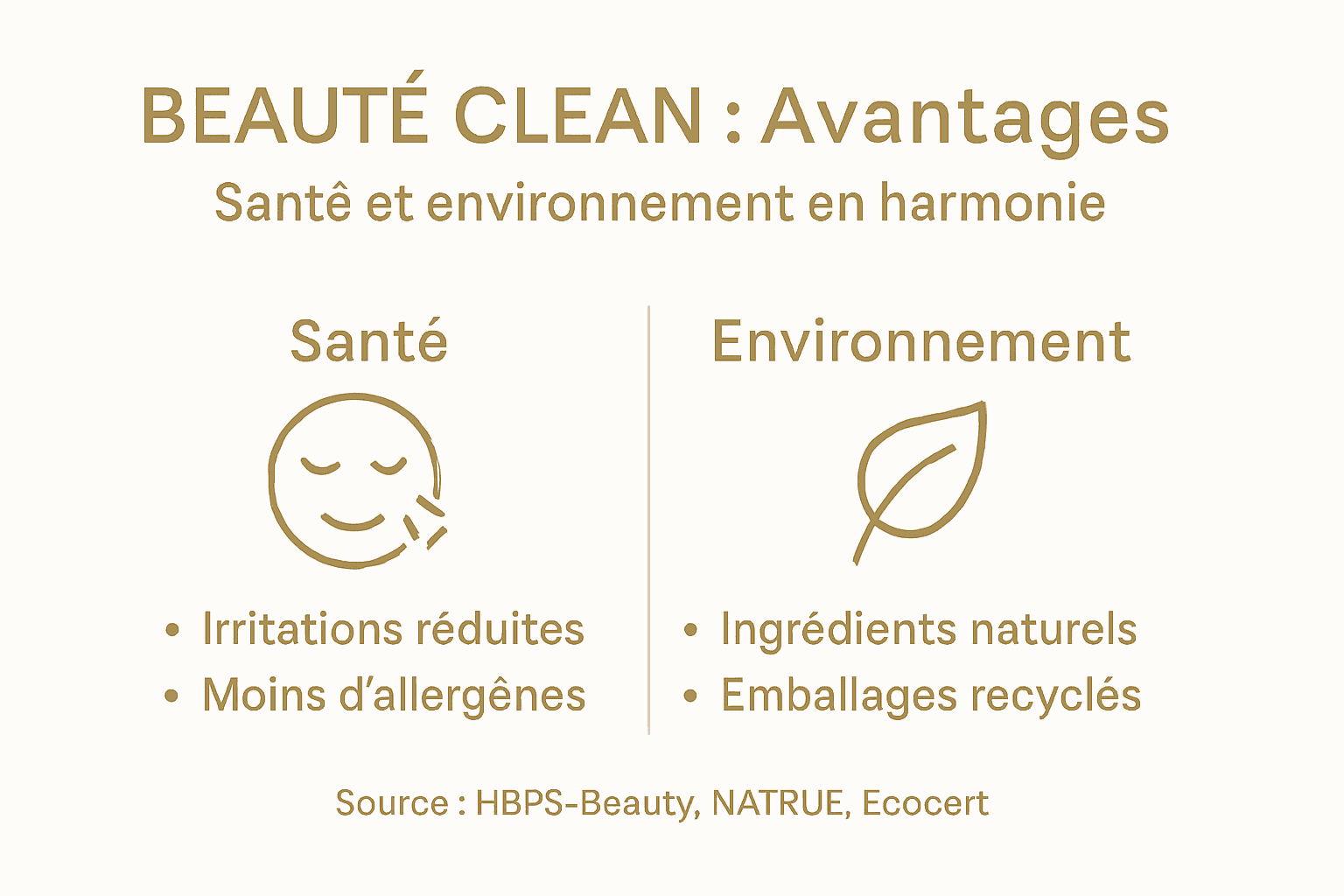
The benefits extend far beyond your skincare routine. They touch on your overall well-being, your skin, and the ecosystems that surround us.
The direct benefits for your skin
Clean products considerably reduce certain skin risks. Here is what you gain:
- Less irritation: the absence of harsh ingredients limits redness and itching
- Reduction of allergic reactions: tested formulas composed of organic and natural ingredients
- Healthier skin in the long term: no accumulation of questionable substances in your pores
- Improvement for sensitive skin: these products are particularly suitable for people with known sensitivities
Your skin absorbs part of what you apply. Choosing clean means controlling what really enters your epidermis.
The positive environmental impact
Beyond your skin, clean beauty transforms your environmental footprint. Eco-responsible beauty products aim to limit water pollution, chemical contamination, and energy consumption.
Committed brands adopt concrete practices: recyclable or reduced packaging, ingredients from sustainable sources, and carbon footprint reduction. Every purchase supports this change.
Protecting ecosystems
When you use conventional cleaning products, chemical substances end up in wastewater. They pollute rivers, groundwater, and impact aquatic life.
The natural and organic ingredients of clean products break down more easily and cause less ecological damage. It is a virtuous circle: your health and that of the environment progress together.
Long-term benefit for overall health
Choosing clean means also thinking about your future health. Repeated exposure to certain questionable substances accumulates effects on your body. By minimizing this exposure now, you reduce long-term risks.
This approach is called sustainable beauty, and it recognizes that your personal well-being is inseparable from public and environmental health. Healthy skin contributes to a healthy body and a healthier planet.
Verify environmental claims
Not all products labeled “eco-friendly” are equal. Look for concrete evidence:
- Certified organic ingredients
- Packaging that is genuinely recyclable or compostable
- Brands that are transparent about their supply chain
- Recognized environmental labels
Pro tip: Start by replacing one or two problematic products with clean alternatives rather than revolutionizing your routine all at once. This makes the transition easier and helps you identify the products that are truly right for your skin.
Greenwashing and mistakes to avoid
Greenwashing exists everywhere in the clean beauty sector. Brands exploit your environmental goodwill to sell products that are not truly clean.
This deceptive practice harms both your wallet and the planet. Learning to recognize it is essential.
What exactly is greenwashing?
Greenwashing or eco-whitewashing consists of making unfounded or exaggerated environmental claims. Brands promise you clean beauty without truly offering it.
Common pitfalls include the excessive use of green colors, images of idyllic nature, and vague or unverified claims such as “recyclable” or “organic.” Deceptive environmental claims mislead consumers without any scientific basis.
Warning signs to know
Some brands play on your emotions rather than the facts. Here are the most common greenwashing techniques:
- Excessive use of green colors without product justification
- Images of leaves or nature with no connection to the composition
- Generic claims such as “natural” or “eco-friendly” without certification
- Self-created voluntary badges that resemble official labels
- Absence of an INCI list or hidden information
- Vague promises without scientific evidence
A truly clean product displays its official certifications and its complete composition without evasion.
How to avoid pitfalls
Recent European directives require full transparency. Environmental claims must be scientifically verified and documented, prohibiting uncertified badges.
Always check the actual composition of the product. Ask yourself: does the brand display recognized official labels? Is the INCI list accessible? Are the claims supported by evidence?
Common mistakes to avoid
Even with the best intentions, you risk falling into these traps:
- Believing that “natural” automatically means clean
- Buying based on packaging alone, without checking the composition
- Confusing private labels with official certifications
- Neglecting to read the INCI list in detail
- Accepting promises without asking for evidence
Verify the legitimacy of a brand
Before buying, ask these simple questions:
- Is the displayed label officially recognized (NATRUE, Ecocert, Cosmos)?
- Is the complete composition available and readable?
- Does the brand explain its ecological or ethical processes?
- Are there independent reviews of this product?
Pro tip: Use independent databases such as EWG Skin Deep to check each ingredient before buying. This protects you against deceptive marketing promises and helps you identify truly clean products.
Embrace Clean Beauty with HBPS-Beauty.com for Healthy and Transparent Skincare
Are you looking for skincare that respects your skin and the environment while avoiding the pitfalls of greenwashing and questionable ingredients? Clean beauty is an invitation to know what you apply. On HBPS-Beauty.com, discover a carefully selected range of certified and transparent products, tailored to your wellness needs and your quest for purity.
Take action today by exploring our ranges of at-home beauty devices, skincare products, and anti-aging treatments that meet the criteria of clean beauty. Leave no room for doubt: trust an expert platform that highlights quality, safety, and clarity. Browse our offers on HBPS-Beauty.com and transform your beauty routine into a conscious and beneficial act.
Frequently Asked Questions
What is clean beauty?
Clean beauty is a concept that aims to avoid the use of irritating ingredients, allergens, and potentially harmful substances in skincare products, while promoting an approach that respects health and the environment.
How to recognize a clean beauty product?
A clean beauty product is recognized by its transparent labeling, the absence of prohibited substances, a simplified composition, and compliance with environmental standards.
Does clean beauty mean that all natural ingredients are safe?
No, a natural ingredient is not automatically risk-free. Even natural substances can irritate or cause allergic reactions, which is why it is essential to check formulations and know your own skin.
What are the benefits of choosing clean beauty products?
The benefits include reduced skin irritation, fewer risks of allergies, healthier skin in the long term, and a positive environmental impact thanks to more sustainable manufacturing practices.