

How to Choose a Fragrance That Suits Your Profile
TL;DR:
- Choosing a fragrance requires a methodical approach to identify its scent family and test it on your skin.
- Follow the olfactory pyramid, waiting 30 minutes between each stage to assess the fragrance’s true character.
Choosing a fragrance seems simple until you find yourself facing hundreds of bottles, a scent strip in each hand, unsure which one still smells like what. The truth is, knowing how to choose a fragrance that suits you takes a method—not just a good nose. What you smell in a store after a few seconds isn’t the fragrance itself. It’s just the first impression. This guide gives you practical ways to understand your preferences, test intelligently, and invest in a fragrance that truly reflects who you are.
Table of Contents
- Key Takeaways
- Understanding Your Preferences and Fragrance Families
- How to Test a Fragrance Before Buying
- Concentration, Longevity, and Formats: How to Choose
- A Fragrance to Suit Your Personality and Style
- Common Mistakes to Avoid
- My View of Fragrance as an Evolving Signature
- Start Your Collection with the Right Gift Sets
- FAQ
Key Takeaways
| Key Point | Details |
|---|---|
| Know your fragrance families | Identifying the family that suits your personality helps guide every other aspect of your choice. |
| Test on your skin, not just on paper | Your skin transforms a fragrance according to its chemistry; testing on a scent strip isn’t enough. |
| Follow the olfactory pyramid | Never judge a fragrance by its first few seconds; wait at least 30 minutes for the heart notes to emerge. |
| Choose the concentration based on how you’ll use it | Eau de parfum is suitable for everyday wear, while perfume extract is best for special occasions. |
| Avoid impulse purchases | Fragrances bought too quickly without thorough testing are often regretted. |
Understanding Your Preferences and Fragrance Families
Before you even walk into a perfumery, take some time to get to know yourself. Choosing a fragrance should be based on three fundamental criteria: your favorite fragrance family, how it wears on your skin, and the emotions it evokes in you. This three-step approach saves you valuable time.
Ask yourself a few simple questions. What scents do you enjoy in nature? The sea breeze, flowers, the forest after rain, a kitchen filled with the aroma of spices? Your answers already reveal your preferred fragrance family.
The main families to know are:
- Floral: Dominated by rose, jasmine, and peony notes. Often suited to romantic, feminine profiles, but not exclusively.
- Woody: Cedar, sandalwood, vetiver. Often associated with confident, elegant personalities; popular with men but also worn by women.
- Oriental: Amber, vanilla, spices. For sensual, daring profiles, with long-lasting wear.
- Fresh or citrus: Citrus fruits, mint, aquatic notes. Ideal for dynamic personalities or sporty and professional settings.
- Gourmand: Caramel, chocolate, tonka bean. These fragrances have been especially popular in recent years; they’re highly evocative but not for everyone.
Knowing your favorite family immediately narrows a selection of 500 fragrances down to 30. It also helps you avoid dozens of tests that don’t suit you. To learn more about fragrance quality, high-end perfumes are often the best examples of each family.
How to Test a Fragrance Before Buying
The Scent-Strip-Then-Skin Method
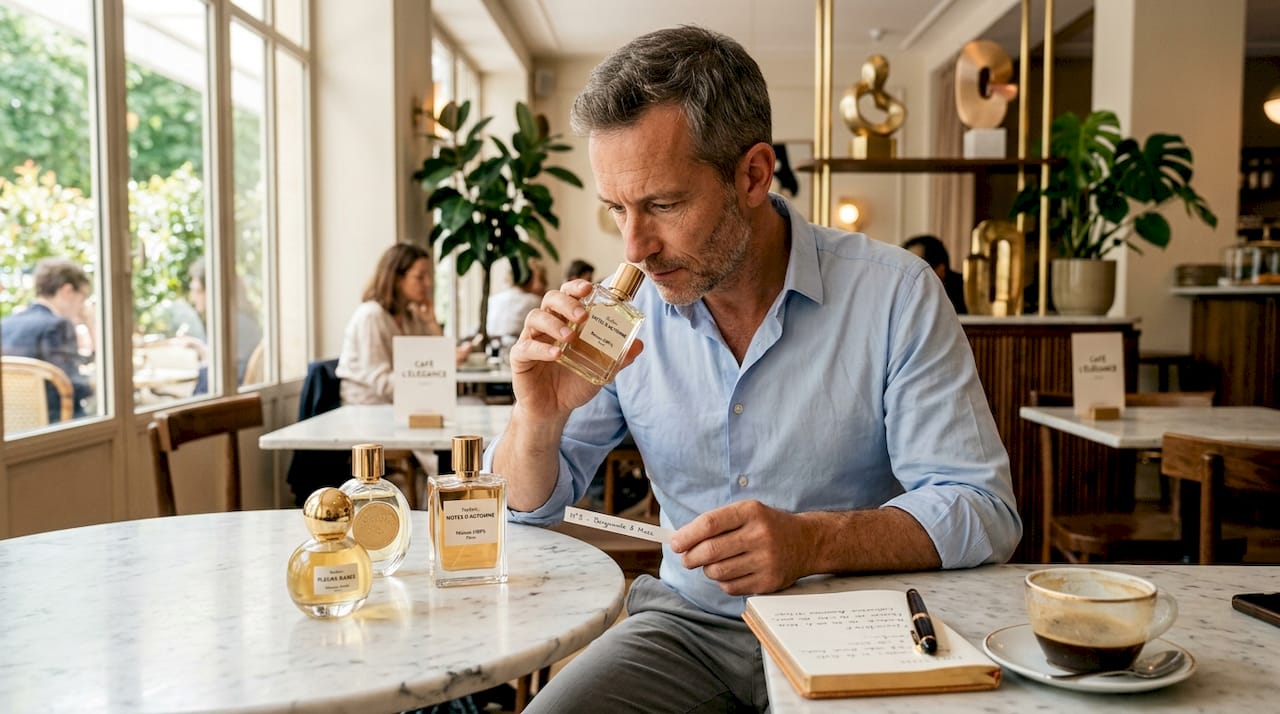
Here’s how to test a fragrance effectively, starting with paper and moving on to your skin:
- Start by spraying it on a scent strip to get a general first impression of its fragrance family.
- If you like the scent, move on to the next step: spray it on your wrists or inner elbows. Your skin’s warmth activates the fragrance’s diffusion and reveals how it really develops.
- Wait at least 30 minutes without rubbing or touching the area. The top notes fade, giving way to the heart notes.
- After an hour, see what remains. These are the fragrance’s base notes—its true signature.
- For a thorough test, wear the fragrance for a full day using a sample.
Testing several fragrances in one session quickly tires your sense of smell. Limit yourself to 3 or 4 per visit, and come back another time to compare them.
Pro tip: Smell ground coffee between tests to reset your sense of smell. Perfumery professionals use this method to compare fragrances without overwhelming their noses.
Understanding the Olfactory Pyramid
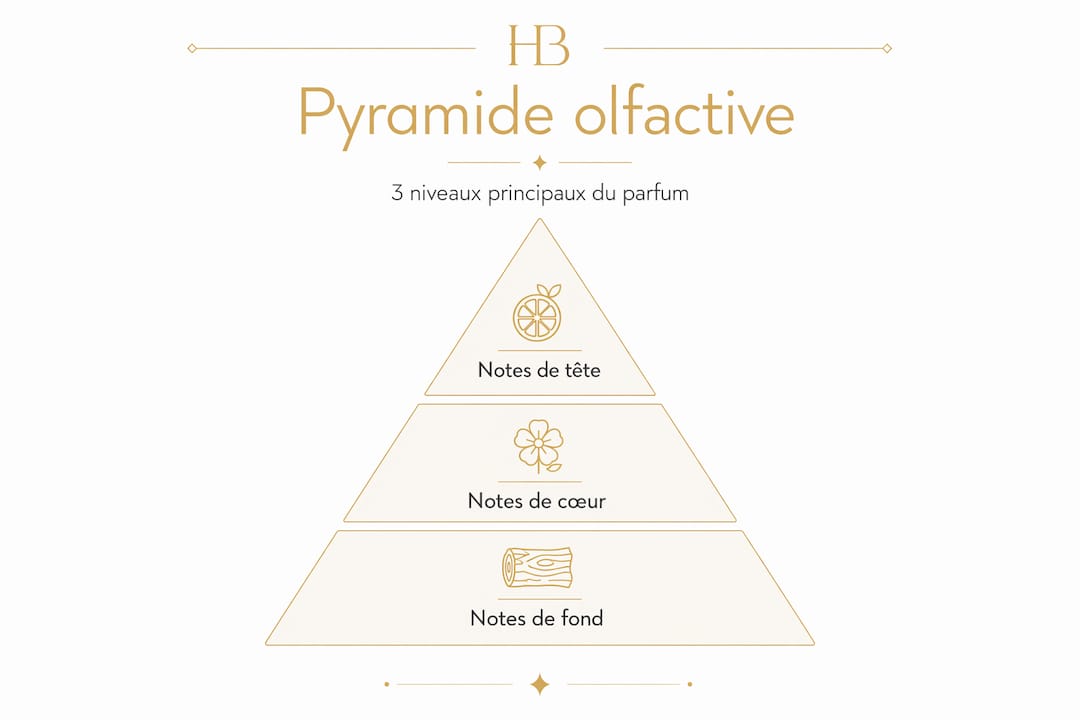
A fragrance isn’t one uniform blend. It unfolds in three successive stages on the skin:
Top notes: What you smell in the first 5 to 15 minutes. Light and volatile, they create the first impression but don’t represent the entire fragrance. Heart notes: The heart of the fragrance, noticeable between 30 minutes and 3 hours. This is where its true character comes through. Base notes: The final notes that linger for hours after application. They define the trail and lasting signature.
Never judging a fragrance by its first notes is a golden rule that many people still overlook. Yet it’s what separates a successful purchase from a bottle left gathering dust.
Concentration, Longevity, and Formats: How to Choose
The concentration of fragrance oils in a product directly determines its longevity and intensity. It’s a factor that’s often overlooked when choosing the right fragrance.
| Format | Concentration | Estimated longevity | Recommended use |
|---|---|---|---|
| Eau de cologne | 3 to 5% | 1 to 2 hours | Exercise, hot weather, light wear |
| Eau de toilette | 5 to 12% | 3 to 5 hours | Everyday wear, office |
| Eau de parfum | 12 to 20% | 6 to 8 hours | Versatile everyday wear, evenings |
| Perfume extract | 20 to 40% | 8 to 12 hours | Special occasions |
The concentration of fragrance oils therefore determines both a product’s intensity and its value for money. An extract is used in smaller amounts, which offsets its higher price.
Eau de parfum offers the best balance of intensity and longevity for everyday wear. For professional or sporting settings, eau de toilette is more discreet and light. Having several fragrances for different occasions isn’t a luxury; it’s simply a smart way to adapt your image to the setting.
A Fragrance to Suit Your Personality and Style
Fragrance is a subtle extension of your personality. It evolves over the years and in different settings, just as you do. Here’s how to create harmony between your fragrance and your identity:
- Bold, confident profile: Intense oriental and woody scents (oud, amber, spices) amplify a natural presence. They pair perfectly with structured clothing, such as a suit or evening look.
- Reserved, elegant profile: Powdery florals or light woody scents are a better fit. They don’t dominate a space, but leave a memorable trail.
- Dynamic, sporty profile: Fresh and citrus scents are the best fit. They feel light and work well with casual or outdoor styles.
- Romantic profile: Fruity florals or soft musks create a gentle, warm aura. Ideal for intimate occasions or days spent outdoors.
Seasonality also plays a practical role. In summer, light, fresh fragrances are a natural choice, as heat amplifies the notes and can make heavier ones feel overwhelming. In winter, oriental and woody scents hold up better in the cold and bloom on the skin. To explore how to adapt your fragrance to the seasons, you can apply lifestyle themes to your fragrance wardrobe.
Pro tip: Before buying a fragrance for a specific occasion (a wedding, interview, or trip), test it in a similar setting. A fragrance that seems perfect in a store may feel too strong in an air-conditioned meeting room.
Common Mistakes to Avoid
What Most People Do
Buying a fragrance because a friend recommended it, a celebrity wears it, or it’s a bestseller is one of the most common mistakes. Fragrance reacts differently depending on each person’s skin pH and individual chemistry. What smells divine on someone else may smell ordinary—or even unpleasant—on you.
Here are the pitfalls to avoid:
- Judging by the first few seconds: The most common mistake is deciding before letting the fragrance develop. Top notes disappear within 15 minutes.
- Buying without testing it on your skin: A scent strip gives you an idea, not certainty.
- Over-spraying: More isn’t better. Two or three sprays on pulse points are more than enough.
- Overlooking where to apply it: Your wrists, neck, and the area behind your ears help optimize diffusion through your body heat. Moisturizing your skin before application also improves staying power.
- Choosing based on brand or price: A fragrance that suits you is better than an expensive one that doesn’t reflect who you are.
To compare beauty brands objectively before making a purchase, use a clear set of criteria to avoid regrets.
My View of Fragrance as an Evolving Signature
It took me years to understand that I wasn’t looking for a fragrance. I was looking for a version of myself that I wanted to project. That distinction changes everything.
Over time, I’ve learned never to rush. A fragrance tested in a store in the morning may surprise you in the evening, after a full day on your skin. What you smell and feel emotionally when you encounter a fragrance is the most reliable signal there is. If it makes you smile, that’s a good sign.
I’ve also noticed that many people look for “the one” fragrance, the one they’ll wear their whole life. That’s a rigid way of thinking. Your olfactory signature evolves with you, your preferences, and the different phases of your life. Having two or three fragrances for different occasions shows olfactory maturity, not indecision.
Gourmand and musky trends are appealing to many people right now, but trendy notes don’t suit everyone. My advice: try them, but don’t choose them just because they’re popular. Choose them because they suit you.
— JSCC
Start Your Collection with the Right Gift Sets
You now have the method. All that’s left is to put it into practice. At Hbps-beauty, two gift sets stand out, whether you’re starting a collection or adding to one.
The Paco Rabanne 1 Million gift set is a go-to choice for confident, charismatic profiles. Its leather, spice, and wood notes create a powerful woody oriental scent, ideal for evenings or making an impression. The Paco Rabanne Invictus gift set is suited to dynamic, modern personalities, with fresh marine notes over a woody base. Both sets include several formats, allowing you to test the concentration that suits you before choosing your preferred size. That’s precisely the method described in this article, applied to two renowned classics.
FAQ
What’s the difference between eau de toilette and eau de parfum?
Eau de toilette contains 5 to 12% fragrance oils and lasts around 3 to 5 hours. Eau de parfum, at 12 to 20%, lasts 6 to 8 hours and has a more pronounced intensity.
How many fragrances should you test in one session?
Limit yourself to 3 or 4 fragrances per session to avoid overwhelming your sense of smell. Smell ground coffee between tests to reset your nose.
Can you choose a fragrance without testing it on yourself?
No. Every fragrance reacts differently depending on your skin’s pH. Testing on a scent strip gives you a first impression, but testing on your skin is essential to make the right choice.
When should you change your fragrance according to the season?
Choose fresh, light fragrances in spring and summer, and oriental or woody scents in fall and winter, as heat amplifies notes while cold mutes lighter fragrances.
Is an expensive fragrance necessarily better?
Not necessarily. A fragrance that suits your personality and skin chemistry is always better than an expensive one that doesn’t suit you.
Recommendations
- High-end fragrance: quality, experience, and distinction – HBPS Beauty & Fashion
- Professional fragrance diffuser: build customer loyalty and enhance your space – HBPS Beauty & Fashion
- How to compare beauty brands for the best purchase – HBPS-Beauty
- How to choose beauty products for a personalized routine – HBPS-Beauty