

Hyaluronic acid explained simply for you
Hyaluronic acid is a natural glycosaminoglycan that retains water and maintains the hydration, volume, and suppleness of tissues. It is found in the extracellular matrix, the synovial fluid of joints, and the vitreous humor of the eye, where it plays both a structural and functional role. Its cosmetic reputation stems from a simple property: this molecule captures and retains water, which explains its use in both an affordable serum and an injection syringe administered in a medical office.
Three uses coexist, and it is best to distinguish them from the outset so as not to confuse their respective promises.
- Topical: surface hydration, temporary plumping effect, action limited to the outer layers of the skin.
- Oral: dietary supplements aimed at supporting skin hydration and joint comfort, with still modest evidence.
- Injectable: wrinkle filling, volume restoration, supervised medical procedure.
If you are considering an injection, consulting a qualified healthcare professional remains essential: it is not a trivial procedure, even if the technique is common, as the Laser Derma medical laser center in Balaruc-les-Bains & Béziers reminds us.
Key Points
Hyaluronic acid hydrates by retaining up to 1,000 times its weight in water, but its effectiveness and duration of action depend entirely on the form used, the molecular weight, and the area treated.
| Point | Details |
|---|---|
| Three distinct uses | Topical hydrates on the surface, oral supports over several weeks, injectable fills or stimulates depending on the product chosen. |
| Molecular weight matters | A large molecule remains on the surface, a fine molecule penetrates the epidermis more. |
| Production declines with age | From 25 to 30 years old, which affects skin firmness. |
| Injections are regulated | Since July 2024, their dispensing requires a medical prescription in France. |
| Effects are temporary | One-third of the body's hyaluronic acid is renewed every day, hence the need for repeated treatments. |
Table of Contents
- Chemical structure and physical properties of hyaluronic acid
- Where is hyaluronic acid found in the body and what is it used for?
- Serums, capsules, or injections: which forms to choose?
- How is hyaluronic acid made today?
- What do hyaluronic acid serums and creams really do?
- Hyaluronic acid injections: areas, duration, and who can perform them
- Medical applications: beyond aesthetics
- What does science really say about its effectiveness?
- Side effects, risks, and contraindications to know
- How to choose a treatment or prepare for an injection with confidence
- Should we really rely entirely on hyaluronic acid?
- Sources
Chemical structure and physical properties of hyaluronic acid
A glycosaminoglycan is a long chain of repeating sugars that winds through the extracellular matrix, the space between skin cells and connective tissues that serves as their hydrated scaffold. Hyaluronic acid is one of its most studied representatives, alongside collagen and elastin, with which it works synergistically.
Its most striking property remains its ability to retain water: a hyaluronic acid molecule can bind up to about a thousand times its own weight in water. Concretely, one gram of this substance can immobilize nearly a liter of water in a viscous gel. It is this mechanism, and not some miracle effect, that explains the sensation of plumped skin after applying a well-formulated treatment.
However, everything does not play out the same way depending on the size of the molecule, what is called the molecular weight:
- High molecular weight: large molecules that remain on the surface and form an occlusive film limiting transepidermal water loss.
- Low molecular weight: smaller fragments capable of penetrating further into the epidermis and acting deeply.
- Mixed molecular weight: combination of the two formats to combine an immediate effect and a more lasting action.
This distinction is not a marketing detail. It directly conditions what a product can really do on your skin, and it is often the least explained information on labels.
Where is hyaluronic acid found in the body and what is it used for?
Hyaluronic acid is not limited to the skin. It is found in several tissues where it fulfills very different functions from one another.
- The dermis: it maintains skin hydration, volume, and firmness alongside collagen.
- Synovial fluid of the joints: it acts as a natural lubricant, cushioning friction between bone surfaces.
- The vitreous humor of the eye: this transparent gel that fills the eyeball owes its consistency largely to this molecule.
- Connective tissue in general, where it participates in structural support and cell migration during healing.
Its biological function goes beyond simple water storage. When a tissue is injured, hyaluronic acid intervenes in the inflammatory signals that trigger repair, then in the reconstruction of the extracellular matrix. Its degradation, ensured by enzymes called hyaluronidases, is an integral part of this cycle: produce, use, degrade, reproduce.
A often ignored fact: natural production declines with age, from 25 to 30 years old, and drops even further after fifty, where the skin no longer contains more than a significantly reduced quantity compared to young adulthood. This decline partly explains why the skin loses firmness and bounce over time, regardless of sun exposure or lifestyle. Research is also interested in the role of this molecule in certain tumor processes, where its abnormal degradation sometimes serves as a biological marker, a field still largely exploratory on the clinical side.
Serums, capsules, or injections: which forms to choose?
The three families of hyaluronic acid-based products do not substitute for one another; they meet different needs.
Cosmetic forms, serums and creams foremost, act on the surface. They hydrate the epidermis and give a temporary plumped appearance, but their action remains limited to the outer layers of the skin: they do not fill a deep wrinkle or replace lost volume at the level of the cheekbone.
Oral supplements promise support from within, for both the skin and joints. Several recent trials show encouraging results on skin hydration and joint comfort, but the level of evidence remains significantly lower than that of injections. These capsules act rather as support over several weeks than as an instant solution, a point that many packages keep silent about.
Finally comes the injectable, which itself is divided into two large technical categories:
- Cross-linked: the molecular chains are chemically linked to each other to slow down degradation. This is the basis of fillers used to fill and give volume.
- Non-cross-linked: the molecule remains in its natural form, more fluid, used in skinboosters to improve skin quality without creating volume.
Concentration and the salt used also matter: sodium hyaluronate, the most stable and common form, serves as the reference in the majority of professional and consumer formulations.
How is hyaluronic acid made today?
Forget the old extraction methods from rooster combs, largely abandoned since the 2000s. The vast majority of hyaluronic acid used today, in cosmetics as in medicine, comes from biofermentation: bacteria, most often modified and non-pathogenic strains of Streptococcus, produce the molecule in controlled fermentation tanks.

This industrial process presents a double advantage: superior purity and better reproducibility than animal extraction, which carried a risk of biological contamination. After fermentation comes an advanced purification step, where several critical parameters are controlled: endotoxin content, viscosity, degree of cross-linking for injectable products, and absence of bacterial residues.
Pro tip: Beware of products sold at a bargain price without a clear mention of origin or regulatory compliance, especially for dietary supplements imported outside of classic channels. Poorly purified hyaluronic acid can cause unexpected skin reactions, even in topical application.
Traceability is not an empty marketing argument here. It directly conditions the safety of the product you apply or, a fortiori, that a practitioner injects you.
What do hyaluronic acid serums and creams really do?
A good serum hydrates deeply relative and gives a visible plumping effect from the first applications, but this effect remains temporary and depends entirely on the formulation. The best hyaluronic acid creams generally combine several molecular weights to combine surface action and partial penetration, an approach confirmed by several cosmetic formulation analyses.
On the active ingredient combination side, hyaluronic acid combines well with vitamin C in the morning, to reinforce the antioxidant effect, and with retinol in the evening, where it compensates for the dryness sometimes caused by the latter. It does not conflict with almost any other common ingredient, which makes it a flexible routine base rather than an active to isolate.
On the label, two elements deserve your attention before purchase:
- The concentration: effective formulations are generally around 1 to 2% hyaluronic acid, beyond that the marginal interest decreases.
- The announced molecular weight: look for a mention of several molecular sizes ("low, medium, and high molecular weight hyaluronic acid") rather than a simple generic mention.
Pro tip: Apply your serum on slightly damp skin, never completely dry. Hyaluronic acid captures the surrounding water, so without available moisture, it can paradoxically pull water from the deep layers of the epidermis to the surface, an inverse effect of the one sought. To build a coherent routine around this active, our guide on skin hydration details the complementary steps not to neglect.
The limits remain real: a serum, even excellent, never fills a deep wrinkle or restores lost facial volume. For that, you have to change register.
Hyaluronic acid injections: areas, duration, and who can perform them
Aesthetic injections are divided into three large families with distinct objectives. Cross-linked fillers target volume and filling: lips, cheekbones, nasolabial folds, temples, or even non-surgical nose reshaping. Skinboosters, non-cross-linked, aim rather at skin quality and deep hydration, without seeking to create visible volume. Profhilo occupies a separate place: this treatment stimulates the production of collagen and elastin rather than simply filling.
The duration of effects varies greatly depending on the treated area and the injected product:
- Lips and dark circles: highly mobile areas, effects often limited to 6 to 9 months.
- Cheekbones and temples: less mobile areas, effects that can last 12 to 18 months.
- Skinboosters: require repeated sessions, cumulative rather than immediate effect.
One of the major assets of injectable hyaluronic acid, compared to old collagen-based implants, remains its reversibility. Hyaluronidase, an enzyme that dissolves the molecule, allows to correct an unsatisfactory result or treat a complication, provided it is administered by a competent practitioner.
On the regulatory level, caution is increasingly necessary. Since July 1st, 2024, the dispensing of injectable products containing hyaluronic acid is restricted to medical prescription, a measure intended to limit injections performed outside a secure medical framework. This means concretely that an aesthetic injection procedure must be performed by a doctor, a dental surgeon, or a trained midwife, never by a non-medicalized beauty salon.
Medical applications: beyond aesthetics
Hyaluronic acid far exceeds the cosmetic framework. In rheumatology, viscosupplementation consists of injecting the molecule directly into a joint, the knee being the main one, to try to restore the quality of the synovial fluid and relieve arthritic pain. The results are however far from unanimous: several analyses indicate a limited effect compared to the placebo, which has led some health systems to review their reimbursement conditions for this treatment.
In ophthalmology, hyaluronic acid plays a valuable technical role during interventions like cataract surgery, where it protects ocular tissues and facilitates surgical handling thanks to its controlled viscosity. Its natural role in the vitreous humor makes it a logical choice for this type of use.
Other medical applications exist, with varying degrees of evidence: support for tissue healing, protection of weakened mucous membranes like the esophageal mucosa in certain gastrointestinal contexts, or even advanced dressings for chronic wounds. These uses often remain more targeted and less known to the general public than aesthetic injections, but they testify to the real biological versatility of this molecule.
What does science really say about its effectiveness?
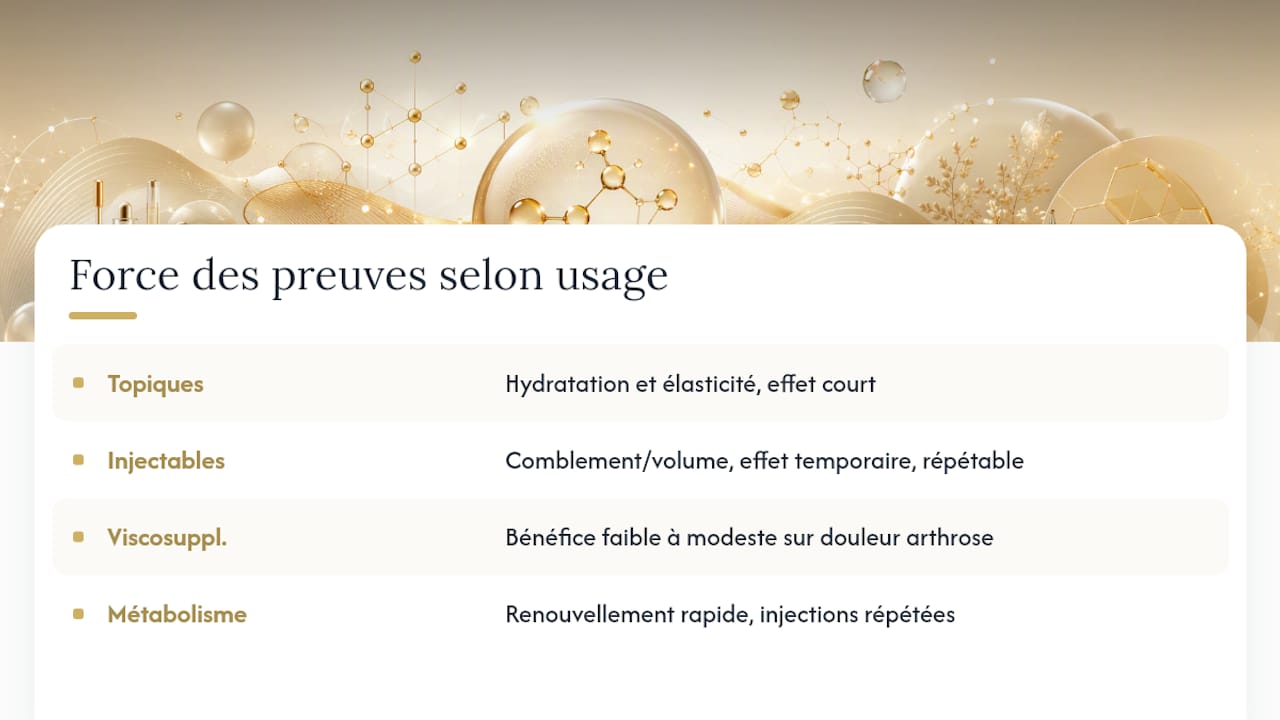
The level of evidence varies greatly depending on the use, and it is probably the point least understood by the general public. Topicals benefit from clinical studies showing a measurable improvement in hydration and skin elasticity, but these results often remain short-term and depend heavily on the tested formulation. Injectables, on the other hand, show a better established effectiveness for filling and volume restoration, with an effect that is certainly temporary but reproducible from one session to another.
Viscosupplementation remains the weak link in the chain of evidence: several analyses report a weak to modest benefit on arthritic pain compared to the placebo, which fuels an ongoing debate between real clinical benefits and risks of adverse effects.
This contrast is worth keeping in mind before any purchase or medical decision: a topical product promising a “plumping effect” comparable to an injection is almost always a case of marketing exaggeration rather than a proven clinical result.
From a metabolic standpoint, one fact sheds light on many behaviors observed in practice: a significant portion of the body’s hyaluronic acid is produced and broken down every day. This rapid turnover explains why injections must be repeated to maintain an aesthetic effect, unlike a surgical procedure, the results of which would be permanent.
Side effects, risks, and contraindications to know
After an injection, local reactions are expected and generally mild: pain at the injection site, redness, bruising, and slight swelling that disappears within a few days. In most cases, these signs should not cause concern.
However, rarer complications do exist and should be known before any procedure:
- Infection at the injection site, requiring prompt medical attention.
- Tissue necrosis, a serious complication related to an injection into a blood vessel.
- Granulomatous reaction, a chronic inflammatory response around the injected product.
- Tyndall effect, a bluish discoloration visible under the skin when the product is injected too superficially.
Certain situations require particular caution or may even be a clear contraindication: an active infection in the area to be treated, documented hypersensitivity to hyaluronic acid, and pregnancy or breastfeeding, for which the precautionary principle prevails in the absence of sufficient safety data.
Pro tip: Intense, persistent pain after an injection, a sudden change in vision, or an area that becomes abnormally pale should prompt you to immediately contact the practitioner or emergency services. These signs may indicate a rare but serious vascular complication that requires prompt intervention.
How to choose a treatment or prepare for an injection with confidence
Before buying a serum or cream, a few simple checks can help avoid disappointment.
- Read the INCI list and look for the exact term “sodium hyaluronate” or “hyaluronic acid” at the beginning of the list, which indicates a significant concentration.
- Check for an indication of multiple molecular weights, which ensures combined action at both the surface and deeper levels.
- Choose brands that can back up their claims with formulation data, not just before-and-after photos.
Before an injection, preparation involves other equally practical questions:
- What is the practitioner’s training in injectable aesthetic medicine?
- What specific product will be used, whether or not it is cross-linked, and from which brand?
- What is a realistic expectation for the duration of the effect in the area concerned?
- What is the protocol in the event of a vascular complication or dissatisfaction with the results?
After the treatment, regular maintenance every 9 to 18 months, depending on the area, helps maintain the results without unnecessarily increasing the number of sessions. To refine your choice of a complementary routine, our page on how to choose a facial treatment suited to your skin details the criteria to consider based on your skin type.
Should you really rely entirely on hyaluronic acid?
The ubiquity of this molecule on cosmetic shelves and in medical offices does not make it a universal solution. A well-formulated serum effectively hydrates, but it cannot replace an injection for lost volume or a sun care routine to prevent skin aging in the first place. These approaches complement each other; they are not substitutes for one another.
For a medical procedure, consulting a qualified professional remains non-negotiable, regardless of any commercial promise heard elsewhere. The best strategy is often the simplest: consistent daily hydration combined with rigorous sun protection, even before considering a more invasive procedure.
Sources
- Hyaluronic acid — Wikipedia
- Hyaluronic acid - What are its benefits? - Que Choisir Ensemble
- Hyaluronic acid capsules: are they a real anti-aging and joint comfort solution? - Futura-Sciences
- Hyaluronic acid: complete guide | Maison Tóā Lausanne
This article provides general information and is not a substitute for the advice of a qualified doctor. Consult a qualified healthcare professional about your personal situation before taking action based on this content.