

Facial steaming: what are the real benefits for your skin?
Yes, steam softens sebum and impurities, making deep cleansing easier and preparing the skin to better absorb your skincare products afterward. The effect is real but modest: stimulated microcirculation, an immediate boost in radiance, and slightly improved product absorption. It is not, however, a medical treatment, and duration matters just as much as technique: aim for 5 to 10 minutes, adjusting the frequency to your skin type.
In brief:
- Steam opens pores and softens sebum, making it easier to gently clear blackheads, especially on oily skin.
- The immediate glow and microcirculation boost are temporary, with no solid evidence of lasting collagen stimulation.
- Heat increases skin permeability, encouraging the absorption of skincare products applied just after a session.
- It is best to limit each session to 5–10 minutes and adjust the frequency to your skin type to avoid irritation or dryness.
- Steam should be used as a preparatory step; follow it with suitable skincare to maximize its benefits.
Table of contents
- The benefits of facial steaming: what the science actually says
- How to steam your face at home safely
- How long and how often should you steam your face?
- Who should avoid facial steaming?
- What to do right after steaming to get the most out of it
- The evidence behind these recommendations
- Should you really add steaming to your routine?
- Choosing a safe facial steamer for home use
- Sources
- Frequently asked questions
The benefits of facial steaming: what the science actually says
Most of the benefits attributed to facial steaming are based on a simple mechanism: moist heat opens pores and softens hardened sebum, making blackhead removal less harsh on the skin. This is the best-documented benefit, and the one that most justifies regular use for oily skin.
Heat also increases blood circulation, giving you the immediate glow you may notice after a session. However, be careful not to confuse a temporary visual effect with lasting transformation: evidence of prolonged collagen stimulation remains limited and largely anecdotal, as Medical News Today notes. Steam gives you a glow, not a facelift.
When it comes to hydration, the distinction matters. Steam temporarily moistens the skin’s surface, but this effect quickly fades unless you seal in that moisture afterward. This is where the real scientific benefit comes in: heat increases skin permeability, a phenomenon documented in research on transdermal absorption, according to research published on NCBI. In practical terms, your serums and creams penetrate more easily right after steaming than when your skin is cool.
Finally, many people use steam to relieve nasal congestion. The relief is real, but temporary: it is not a treatment for a cold or sinusitis, only symptom relief, as the Cleveland Clinic explains.
- Deep cleansing and softening of sebum: a well-established mechanical effect.
- Glow and microcirculation: visible but temporary effects.
- Better absorption of skincare products: supported by research on skin permeability.
- Lasting collagen stimulation: weak evidence, largely anecdotal.
- Relief from congestion: real but short-lived, not curative.
Pro tip: Never consider steam alone a complete skincare treatment. It’s a preparatory step, not an end in itself.
How to steam your face at home safely
There are three main methods: a bowl of hot water with a towel tent, a hot towel placed directly over the face, and an electric facial steamer. Each has its advantages, but all require the same care when it comes to temperature.
- Cleanse your face before exposing it to heat, to avoid pushing surface impurities into open pores.
- Check the water temperature: it should be hot, never boiling. Let it stand for one minute after boiling before leaning over it.
- For the bowl-and-towel method, pour the hot water into a large bowl, drape a towel over your head, and keep your face about 30 centimeters from the water.
- Limit the session to 5 or 10 minutes: beyond that, the risk of irritation increases without any added benefit, a recommendation also made by Healthline.
- With a hot towel, soak a clean cloth in hot water, wring it out, and place it over your face for a few minutes. This method is easiest to control temperature-wise, since the cloth gradually cools.
- With a facial steamer, follow the manufacturer’s temperature settings and clean the reservoir after each use to prevent bacterial growth.
If you add herbs or essential oils to the water, do a patch test first, and never pour pure essential oil directly into boiling water near your face: concentrated vapors can irritate your airways and skin.
Pro tip: Keep your eyes closed and avoid leaning too close to the bowl the first time. It’s better to start farther away and move closer gradually than to burn yourself on your first attempt.
How long and how often should you steam your face?
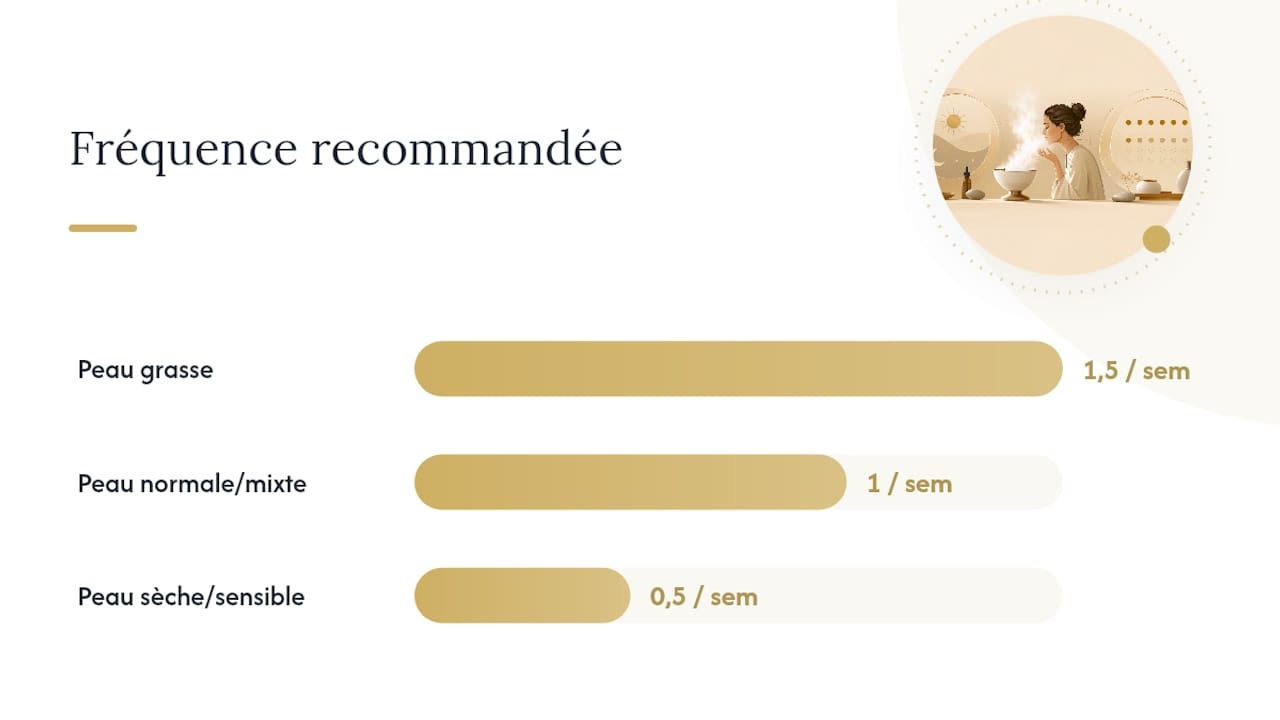
The general rule is simple: 5 to 10 minutes per session, no longer. Beyond that, prolonged heat weakens the skin barrier instead of strengthening it.
Frequency depends entirely on your skin type:
- Oily or blackhead-prone skin: one or two sessions a week are generally well tolerated, according to guidance from WebMD.
- Normal to combination skin: one session a week is enough in most cases.
- Dry or sensitive skin: space sessions one to two weeks apart, or even further apart, and reduce the duration to 3 to 5 minutes.
- Rosacea-prone or very reactive skin: avoid direct steaming or ask a dermatologist for advice first.
Your own skin is still the most reliable guide. If you notice redness that persists after a session, unusual tightness, or irritation flare-ups in the following days, that’s a sign to space sessions out, not make them more intense. Many people make the opposite mistake: they assume blemish-prone skin needs more steam, when overdoing it can actually worsen inflammation.
Who should avoid facial steaming?
Steam is not neutral for every skin type, and some people should be especially cautious.
- Rosacea: heat dilates already fragile blood vessels and can trigger or worsen redness, a risk documented by The Healthy.
- Very reactive skin or active eczema: steam may aggravate inflammation rather than soothe it.
- Severe inflammatory acne: consult a dermatologist before applying heat to already inflamed lesions.
- Water that is too hot or insufficient distance: the risk of skin burns is real, particularly with a bowl of freshly boiled water.
- Steaming too often: over-steamed skin can paradoxically become dry and more sensitive—the opposite of the desired effect.
If you are unsure, or if an unusual skin reaction appears after a session, consult a dermatologist rather than continuing.
What to do right after steaming to get the most out of it
The most common mistake is to go straight to an exfoliant or potent active ingredient after steaming, when the skin is more permeable and therefore more vulnerable to irritation.
- Pat your face dry with a clean towel; do not rub.
- Apply a gentle toner to rebalance your skin’s pH.
- Apply a hydrating mask or serum containing hyaluronic acid or niacinamide while your skin is still slightly damp: this is when absorption is most favorable, a point highlighted by Healthline.
- Finish with a moisturizer to seal in moisture and active ingredients at the skin’s surface.
For dry skin, choose rich, ceramide-based formulas. For oily skin, a lighter niacinamide-based formula avoids a heavy feel without sacrificing hydration.
Pro tip: Don’t wait until your skin is completely dry before applying your products. Skin that is still damp holds on to hydrating ingredients better than skin that has already lost its surface moisture.
The evidence behind these recommendations
This article draws on reputable medical sources rather than marketing promises, and this cautious approach informs each recommendation on duration and frequency.
- Guidelines on session length and frequency draw on several general-interest and medical sources, including Healthline and WebMD.
- Warnings about rosacea and reactive skin are based on cautions published by sources specializing in cosmetic dermatology.
- To extend your routine, the guide to at-home facial massage and the article on the benefits of at-home beauty devices usefully complement this approach to heat-based skincare.
Should you really add steaming to your routine?
Steaming has its place, but as a preparatory step, not a miracle cure. It is most useful for skin prone to blackheads and for those looking to optimize the absorption of a serum or mask.
— JSCC
Choosing a safe facial steamer for home use
A good facial steamer makes a real difference compared with a bowl of hot water: it regulates the temperature, provides a built-in safety distance, and eliminates the risk of spilling boiling water on yourself. The criteria that really matter when buying one are an automatic shutoff, precise temperature control, and an easy-to-clean reservoir to prevent bacterial growth between sessions.

A selection of at-home skincare devices is available, designed for safe everyday use without the guesswork of a DIY setup over a saucepan. If you want to add steaming to your routine without having to guess the right settings, visit the Hbps-beauty store to compare options suited to your skin type and start your ritual this week.
Sources
- 10 Benefits of Face-Steaming and How to Do It at Home
- What to Know About Facial Steaming (WebMD)
- Is steaming your face good for your skin? (Cleveland Clinic)
- Benefits of steaming face (Medical News Today)
- NCBI article relevant to skin permeability
Frequently asked questions
Does facial steaming really work?
Yes, for cleansing and product absorption, effects supported by research on skin permeability, but lasting anti-aging benefits remain poorly substantiated.
How long should a facial steaming session last?
Five to 10 minutes is enough; beyond that, the risk of irritation increases without any added benefit.
How many times a week can you steam your face?
Once or twice a week for oily skin, once a week for normal skin, and no more than once every one to two weeks for dry or sensitive skin.