

Practical guide to optimizing your online beauty purchases
TL;DR:
- Buying beauty products online requires careful preparation: define your needs, analyze the ingredients, and check the seller’s reliability to avoid counterfeits.
- Comparing actual prices, assessing value in use, and securing your transactions are essential for making smart purchases and avoiding unnecessary spending.
Have you ever ordered a cream or serum online with the highest hopes, only to receive a product that doesn’t suit your skin—or worse, a counterfeit? This frustrating experience is far more common than you might think. Shopping for beauty products online offers attractive prices and a huge selection, but it also exposes you to costly mistakes: misleading promotions, incomplete product listings, and unreliable sellers. This guide gives you a step-by-step method to plan, compare, secure, and get the most out of every beauty purchase you make online.
Table of Contents
- Define your needs and prepare your purchase
- Compare prices and assess a product’s true value
- Secure your purchase and choose a trustworthy store
- Optimize costs with cashback and promotions
- Our perspective on optimizing online beauty shopping
- Discover premium beauty products and optimize your purchases
- Frequently asked questions about optimizing online beauty shopping
Key Takeaways
| Point | Details |
|---|---|
| Impulse-buy prevention | Plan your purchase by assessing your needs, the ingredients, and reviews. |
| Compare true value | Don’t focus solely on the initial price; assess the product’s quality and suitability. |
| Make security a priority | Choose trustworthy stores and payment methods to avoid risks. |
| Cost optimization | Take advantage of cashback and stackable promotions to maximize savings. |
| Personalization and ethics | Your choices should reflect your sensitivities and values for a truly optimized purchase. |
Define your needs and prepare your purchase
The preparation stage is arguably the most overlooked part of buying beauty products online. We often click on an ad or a flash sale on impulse without asking ourselves the right questions. The result: a product that ends up at the back of a drawer.
Start with a clear list
Before opening your browser, make a list of your actual needs. What is your skin type: dry, combination, oily, or sensitive? What are your specific goals: radiance, anti-aging, intensive hydration, acne treatment? And what are your preferences in terms of texture, fragrance, or formula (fragrance-free, vegan, natural)? This list acts as a natural filter against impulse buys.
Next, set a firm budget—not for your entire cart, but for each product. Separate your absolute priorities (for example, your daily facial moisturizer) from optional wants (a new serum). This will help you allocate your budget wisely without compromising on essentials. To build a personalized routine that suits you, it helps to start by identifying the essential steps for your profile.
Analyze the ingredients and reviews
Once you’ve shortlisted your options, move on to analyzing the ingredients. The INCI list (International Nomenclature of Cosmetic Ingredients) appears on every legally marketed cosmetic product and helps you identify potential allergens, active ingredients, and fillers. Tools such as Yuka and INCIDecoder make these lists easy to decipher. A skincare product suited to your skin is recognized above all by its formula, not its packaging.
Read verified reviews, but be critical: look for feedback from people whose profiles match yours (skin type, age, similar concerns). A five-star product for oily skin can be disastrous for dry skin. As the analysis in Beauty deals without regrets points out, before buying, check that the offer makes sense (ingredients/INCI, information, reviews) and review the return and refund terms to avoid deals that are too good to be true.
- Note the key active ingredients you’re looking for (hyaluronic acid, retinol, niacinamide…)
- Identify ingredients to avoid based on your sensitivities (synthetic fragrances, denatured alcohol…)
- Check the stated texture (gel, rich cream, dry oil) by reading several reviews
- Compare the size offered (bottle size, amount per application) with the price
Pro tip: Always check the return and refund policy before making your final decision. A site that doesn’t allow returns on sealed, unopened products is a red flag. The best deal is one you can return if it doesn’t suit you.
To take your comparisons further, learning how to compare beauty brands helps you look beyond price and assess reputation, values, and the consistency of product ranges.
Compare prices and assess a product’s true value
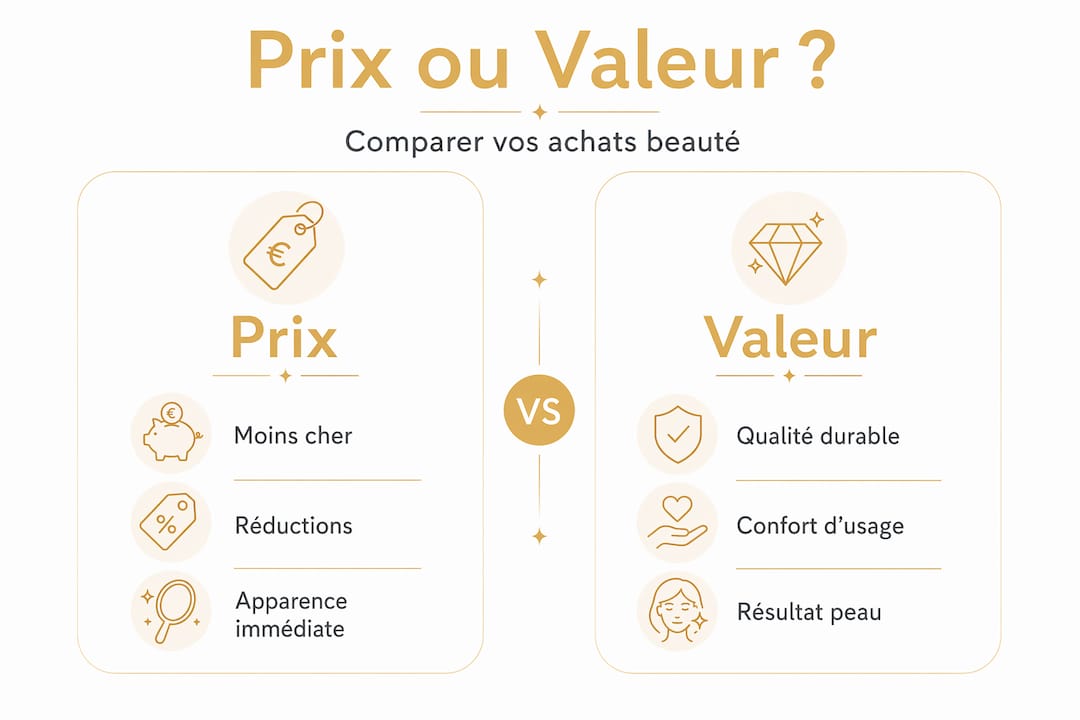
A cheap product that doesn’t suit you actually costs a lot. This paradox lies at the heart of any smart beauty shopping strategy.
Decode crossed-out prices
Sales, promotions, and crossed-out prices are everywhere online. But do you really know what that crossed-out price means? In Europe, regulations require the reference price to be the lowest price charged in the 30 days preceding the promotion. However, not every site follows this rule, and some artificially inflate the original price to make the discount look more impressive. As the analysis published by Beauty deals without regrets points out, when comparing prices, you need to look at the actual reference price, not just the crossed-out price.
For example, if a serum drops from €80 to €40 but was priced at €42 the week before the promotion, the actual savings are marginal. Make a habit of using price-tracking tools to check the price history before buying.
Price vs. value: the key distinction
Here’s a table to help you understand which criteria to consider when evaluating a product:
| Criterion | What to check | Risk if ignored |
|---|---|---|
| Advertised price | Price history over 30 days | False savings |
| INCI ingredients | Active ingredients, allergens | Ineffectiveness or reaction |
| Verified reviews | Profile similar to yours | Unsuitable product |
| Size/dose | Quantity relative to price | High cost per use |
| Return policy | Clear terms | Unable to get a refund |
“An inexpensive product that isn’t right for you (or is uncomfortable to use) will get used less, reducing its perceived value even if the initial price is attractive.” — Cosmetics: Beyond the price
This distinction is fundamental. A €12 foundation that oxidizes on your skin within two hours costs you more than a €35 foundation that lasts 12 hours. The real cost is the cost per use. To refine your assessment of brands and their value for money, see our guide to comparing beauty brands.
Here’s a four-step method for assessing true value:
- Calculate the cost per use: divide the price by the estimated number of doses or uses.
- Cross-check ingredients and reviews: a highly rated product with active ingredients unsuited to your skin won’t help you.
- Compare different sizes: larger sizes are sometimes cheaper per use, but check the expiration date.
- Factor in customer service and the return policy: a site with easy returns and fast refunds reduces your actual financial risk.
Pro tip: Never assume a crossed-out price is a good deal if its basis isn’t clearly stated. If the site doesn’t specify the reference price and the date it applied, treat the promotion with skepticism.
Secure your purchase and choose a trustworthy store
Even the best product at the best price is worthless if the store isn’t trustworthy. Securing the transaction is non-negotiable.
Identify a trustworthy site
Always check these details before placing an order: a SIRET number or equivalent, complete legal information, a physical address and phone number, a secure connection (HTTPS), and independent customer reviews on third-party platforms. As Trusted online store points out, to shop online with confidence and optimize your budget by reducing the risk of ineffective products or counterfeits, you need to verify that the online store is reliable and avoid insecure payment methods.
Warning: On a marketplace, the platform may be well known, but the product seller may be a third party. According to Trusted online store, this directly affects product authentication, return times, and dispute resolution. Don’t confuse the platform’s reputation with that of an individual seller.
Comparison table of seller types
| Seller type | Advantages | Risks |
|---|---|---|
| Brand’s official website | Guaranteed authenticity, direct customer service | Sometimes higher prices |
| Established specialist retailer | Curated selection, expertise | Check reputation and returns |
| Marketplace (third-party seller) | Potentially low prices | Uncertain authenticity, complex disputes |
| Unknown seller | Very low prices | Counterfeits, scams, no recourse |
Here are the warning signs to watch for and the assurances to look for:
- Warning signs: unrealistic prices (50% below the market price), no return policy, bank transfer as the only payment method, a very recently created website, no legal information.
- Assurances to look for: recognized trust seals, free or easy returns, responsive customer service, secure payment (3D Secure), reviews verified by an independent third party.
For more information, our guide to securing your beauty purchase details all the procedures to follow. Choosing reputable beauty brands is also one of the best ways to reduce risk. And if you’re still unsure about the benefits of shopping online, discover the advantages of buying beauty products online that make all the difference.
Optimize costs with cashback and promotions
Once you’ve vetted the store and selected the product, it’s time to pay as little as possible without sacrificing quality. Cashback is one of the most effective and least-used strategies.

How does cashback work?
The principle is simple: you shop through a partner platform (iGraal, Poulpeo, Widilo, etc.), and a percentage of your purchase amount is refunded a few weeks later. As blogbeaute.info explains, cashback can be combined with promotions through dedicated platforms, helping you pay less without compromising the quality of your basket.
Here are the steps to maximize your combined savings:
- Identify any existing promotion on the site: discount code, sale, or current offer.
- Check whether the site is listed on a reputable cashback platform.
- Confirm compatibility: some sites don’t allow discount codes and cashback to be combined.
- Activate cashback before clicking the merchant’s link (don’t navigate via another tab in the meantime).
- Keep proof of purchase and check your cashback tracking in your account.
- Wait for approval (often after the product’s return period, which is 30 to 45 days).
In 2026, beauty shopping is increasingly shaped by personalized shopping journeys and smart recommendations, but cost-effectiveness remains a key consideration for most consumers. Using these tools thoughtfully, while staying focused on your actual needs, is the key to truly optimizing your beauty budget.
Pro tip: Always check that an existing promotion is compatible with cashback before confirming your order. Some discount codes automatically disable cashback, canceling out your double savings. Read the terms and conditions of each offer before clicking.
Prioritize cashback platforms that offer protection in the event of a dispute. If the merchant doesn’t validate your purchase, some platforms have a claims service that lets you recover the cashback you’re owed.
Our perspective on optimizing online beauty shopping
After years of observing beauty shopping habits and helping consumers make choices, we’re convinced that optimization isn’t about price. It’s about suitability.
A €15 product that you happily use every morning and that transforms your skin is infinitely better value than an €80 product bought during a promotion, used twice, and then abandoned. True optimization means finding something that fits into your daily life, respects your skin’s tolerance, aligns with your values (vegan, cruelty-free, made in France), and suits your lifestyle.
What we see all too often is a race to find the lowest price that ultimately disconnects consumers from their actual needs. The strategies presented in this guide (needs list, INCI analysis, cashback, seller verification) are not ends in themselves. They are tools to help you make an informed decision. Building an effective beauty routine requires consistency, not excess.
Our most counterintuitive advice: buy less, but buy better. Resist the temptation to think, “I’ll try it because it’s on sale.” Focus your budget on three or four products that are truly suited to your needs, from brands whose credibility you’ve verified. You’ll save more by avoiding failed purchases than by collecting every promo code in the world.
Discover premium beauty products and make the most of your purchases
The advice in this guide will only make a difference if you apply it to genuinely high-quality products sold by a store you can trust. At HBPS-Beauty, we have carefully curated a selection of beauty and wellness products that meet these criteria: proven effectiveness, reputable brands, and full transparency about ingredients and purchase terms.
For anyone looking to start or enhance their routine with a high-quality beauty supplement, Nu Skin’s multiBeauty Pharmanex is a favorite among many beauty enthusiasts. And if you’re looking to invest in a professional hair-styling tool, the Atmos Dry hair dryer delivers salon-quality performance at home. Every product in our selection is chosen to maximize value for money, in line with the methods described in this guide.
Frequently asked questions about optimizing online beauty purchases
What are the essential criteria for choosing a beauty product online?
Check the ingredients (INCI), verified reviews from people with a profile similar to yours, the return and refund policy, and the seller’s reputation. As Beauty deals without regrets points out, checking that the offer makes sense is essential to avoid deals that are too good to be true.
How can you tell if an online promotion is really a good deal?
Compare the current price with the price history for the past 30 days and make sure the basis for the calculation is clearly stated on the site. According to Beauty deals without regrets, a proper price comparison includes the actual reference price, not just the crossed-out price.
Why should you avoid certain payment methods when shopping for beauty products online?
Bank transfers and Western Union are not secure and do not allow you to dispute a transaction in the event of a problem. According to Trusted Webshop, paying by credit card or PayPal offers better buyer protection.
How can you combine cashback and promotions safely?
Use reputable cashback platforms, check that offers can be combined before placing your order, and always keep your proof of purchase. Cashback platforms let you add an extra discount without compromising the quality of your order.
What should you do if you have a dispute with a marketplace seller?
Contact the seller directly first, then, if you can’t find a solution, file a dispute with your bank or PayPal. As a reminder, according to Trusted Webshop, marketplace sellers are often independent third parties, which can make disputes more complicated to resolve.
Recommended reading
- Online beauty shopping: how to shop safely and successfully – HBPS Beauty & Fashion
- Why shop for beauty products online? 63% of French people do – HBPS Beauty & Fashion
- How to compare beauty brands for the best purchase – HBPS-Beauty
- How to choose beauty products for a personalized routine – HBPS-Beauty