

At-Home Skincare Routine Guide: Steps and Tips
In short:
- An effective at-home skincare routine is based on three daily steps: cleansing, moisturizing, and sun protection, repeated for at least six weeks.
- It is essential to use products suited to your skin type, follow the application order, and avoid overloading your skin with too many products.
An at-home skincare routine is a series of targeted daily steps, combining gentle cleansing, appropriate moisturizing, and sun protection to care for your skin without overloading it. The three fundamental pillars of any effective routine are cleansing, moisturizing, and protection. Consistency matters more than the number of products: 6 to 8 weeks of consistent application are necessary to see visible results, as the skin renews itself every 28 days. This at-home skincare routine guide gives you the tools to build a simple, personalized, and long-lasting routine.
What are the prerequisites for a successful at-home skincare routine?
A good at-home beauty routine starts before you even open a bottle. You need the right products, a clean environment, and a few suitable tools.
The basic products you need
- A gentle cleanser suited to your skin type (gel for oily skin, milk or oil for dry skin)
- A lightweight moisturizer in the morning, and a more nourishing one in the evening if needed
- Sunscreen with at least SPF 30, essential year-round because UVA rays penetrate glass and accelerate premature aging
- A targeted serum based on your needs (anti-aging, radiance, sebum control)
The environment and tools
When preparing at-home treatments such as a clay mask, avoid metal utensils. Metal alters the purifying properties of clay. Use glass or ceramic bowls and wooden spatulas instead. Work on a clean surface and wash your hands before each application.

Each treatment takes between 3 and 5 minutes. It is not long, but the consistency of this daily time commitment makes all the difference over several weeks.
Internal hydration also supports your skin from within. Drinking 1.5 to 2 liters of water a day and sleeping 7 to 8 hours a night improves complexion and skin firmness. No product can compensate for a chronic lack of sleep.
Pro tip: Store your products away from light and heat. Heat degrades active ingredients such as vitamin C and retinol, even in sealed bottles.
What are the steps of an at-home skincare routine, and in what order?
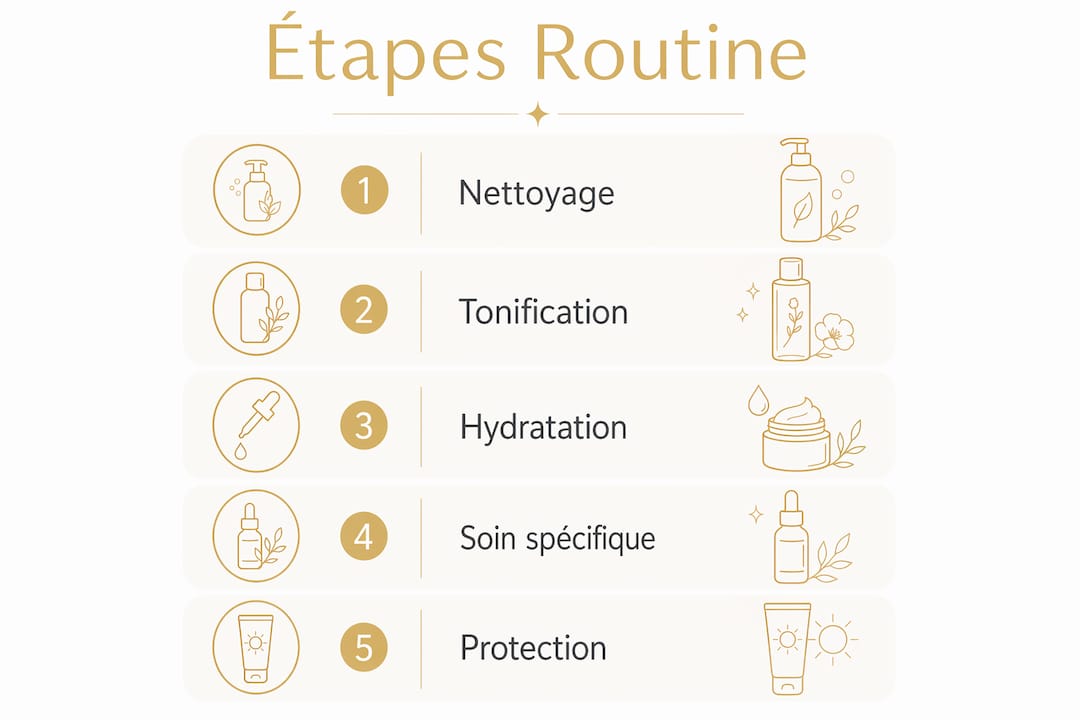
The application order of products follows a simple rule: from thinnest to richest. Applying an oil before a water-based serum blocks the active ingredients and reduces their effectiveness. Here are the steps in the optimal order.
Morning routine
- Light cleansing: rinse your face with lukewarm water or use a gentle cleanser. In the morning, the skin has not accumulated pollution or makeup.
- Targeted serum (optional): apply a vitamin C serum for radiance or a hyaluronic acid serum for hydration to slightly damp skin.
- Moisturizer: choose a lightweight texture, such as a gel or fluid, that absorbs quickly.
- Sunscreen with at least SPF 30: this is the most often neglected yet most protective step. Apply it last, after your cream.
Evening routine
- Double cleansing: start with an oil or balm to dissolve makeup and sunscreen, then follow with a gentle gel to remove residue. This double cleansing is recommended only in the evening.
- Gentle exfoliation (1 to 2 times a week): choose between mechanical exfoliation (gentle scrub) or chemical exfoliation (low-concentration AHA or BHA). Sensitive skin should opt for enzymes or PHAs.
- Mask (1 to 2 times a week): a moisturizing mask for dry skin, a purifying clay mask for oily skin, or a soothing mask with oatmeal or aloe vera for sensitive skin.
- Targeted active serum: evening is the best time for active ingredients such as retinol or niacinamide. Gel or fluid textures promote absorption and nighttime cell renewal.
- Night cream: richer than the morning cream, it supports skin repair during sleep.
Morning / evening comparison
| Step | Morning | Evening |
|---|---|---|
| Cleansing | Simple, water or gentle cleanser | Double cleansing (oil + gel) |
| Exfoliation | No | 1 to 2 times a week |
| Mask | No | 1 to 2 times a week |
| Serum | Vitamin C, hyaluronic acid | Retinol, niacinamide |
| Moisturizer | Light cream | Rich cream or balm |
| Sunscreen | At least SPF 30 mandatory | No |
Pro tip: Apply your serum to slightly damp skin. Residual moisture helps active ingredients penetrate faster and reduces the risk of irritation, especially with retinol.
How to personalize your routine according to your skin type?
Each skin type has different needs. Adapting your skincare to your skin prevents reactions and improves results. Here are the characteristics and specific tips for each profile.
The four skin types and their needs
- Dry skin: tightness, lack of radiance, tendency toward flaking. Opt for creamy cleansers, creams rich in ceramides or shea butter, and avoid alcohol-based formulas.
- Oily skin: shine, enlarged pores, tendency toward blemishes. Choose salicylic acid cleansers, oil-free gel moisturizers, and active ingredients such as niacinamide to regulate sebum.
- Combination skin: oily T-zone (forehead, nose, chin) and normal to dry cheeks. Apply different products to different areas if necessary, or choose balancing formulas.
- Sensitive skin: redness, reactivity to temperature changes or new products. Sensitive skin should opt for gentle alternatives such as enzymes or PHAs rather than classic AHAs.
Ingredients to avoid based on sensitivity
| Skin type | Ingredients to avoid |
|---|---|
| Dry skin | Denatured alcohol, strong fragrances, high-concentration AHAs |
| Oily skin | Comedogenic oils (coconut, linseed), heavy butters |
| Sensitive skin | Fragrances, harsh preservatives, strong retinol from the start |
| Combination skin | Products that are too drying or too occlusive |
For sensitive skin, test each new product on the inside of your wrist for 48 hours before applying it to your face. This simple precaution prevents most reactions. You will find skincare tips tailored to each skin profile to refine your product selection.
Introduce new treatments one by one over a period of 10 to 15 days. This method makes it possible to precisely identify the ingredient responsible for irritation if it occurs.
What common mistakes should you avoid in an at-home routine?
The most common mistakes do not come from a bad product. They come from improper use or overzealousness.
- Layering too many products: five different serums applied together do not add up. They neutralize each other or irritate the skin. Two targeted active ingredients are enough in an effective routine.
- Applying products in the wrong order: an oil applied before a water-based serum forms an impermeable barrier. The water-based active ingredients can no longer penetrate. Always follow the rule from thinnest to richest.
- Exfoliating too often: exfoliating every day damages the skin barrier. Once or twice a week is the maximum recommended, even for oily skin.
- Using metal utensils with clay: metal reacts with the minerals in the clay and reduces its purifying power. Always use glass, ceramic, or wood.
- Introducing several new products at the same time: if a reaction appears, you will not know which product is responsible. Introduce only one new treatment at a time.
- Neglecting sun protection after exfoliation: exfoliation makes the skin more sensitive to UV rays. Skipping SPF after a peel or scrub accelerates dark spots and aging.
An effective at-home skincare routine is based on consistency and simplicity, not on multiplying products. Fewer steps, better executed, yield better results.
Key points
An effective at-home skincare routine is based on three daily steps: cleansing, moisturizing, and sun protection, applied in the correct order and repeated for at least 6 weeks for visible results.
| Point | Details |
|---|---|
| Three essential pillars | Cleansing, moisturizing, and at least SPF 30 form the basis of any effective routine. |
| Application order | Always apply from thinnest to richest to ensure the absorption of active ingredients. |
| Consistency over 6 to 8 weeks | The skin renews itself every 28 days: patience is a step in its own right. |
| Personalization by skin type | Adapt cleansers, active ingredients, and textures to your skin profile to avoid irritation and imbalances. |
| Gradual introduction | Test one new product at a time over 10 to 15 days to isolate any reaction. |
Skinimalism: why fewer products yield better results
I have tested dozens of routines over the years, some with eight steps, others with twelve. The conclusion is always the same: the skin that improves the most is the one that has simplified, not the one that has accumulated.
The skinimalism movement, which consists of reducing your routine to the essentials, is not a passing trend. It is a logical response to the product overload that many people impose on themselves without results. The skin barrier is fragile. Multiplying it with powerful active ingredients every night ends up weakening it rather than strengthening it.
What I also observe is that people who understand their skin, who know how to recognize dehydration from oily skin, or a reaction from a simple temporary redness, achieve much better results than those who blindly follow TikTok trends. Knowing your own skin is worth more than any trendy serum.
My recommendation: start with only three products for one month. A cleanser, a moisturizer, an SPF. Observe. Then add a targeted active ingredient if a specific need persists. This progressive approach respects the skin and gives you real data on what works for you.
— JSCC
Hbps-beauty: products suited to your facial routine
Building an effective routine requires reliable products, formulated to meet specific needs.

Hbps-beauty offers a selection of facial skincare products from renowned brands such as Nu Skin and Pharmanex, designed to complement every step of your routine. The Beauty Focus MultiBeauty Pharmanex is designed to support skin hydration and protection from within, complementing daily topical treatments. To go further in your daily skin care, Hbps-beauty brings together on a single platform the best facial skincare products, at-home beauty devices, and tips to refine your at-home beauty routine.
Frequently asked questions
How long does it take to see results with a skincare routine?
The first visible results appear after 6 to 8 weeks of regular application. The skin renews itself every 28 days, which explains this timeframe.
Should you apply sunscreen even in winter or on cloudy days?
Yes. UVA rays penetrate glass and clouds all year round. At least SPF 30 is recommended every morning, regardless of the season.
Can you create an at-home skincare routine with natural ingredients?
Yes, provided you follow hygiene precautions and use suitable tools. For clay masks, avoid metal and prefer glass or ceramic to preserve the purifying properties.
How do you know if a product is right for your sensitive skin?
Test the product on the inside of your wrist for 48 hours before applying it to your face. Introduce only one new treatment at a time over 10 to 15 days to identify any reaction.
What is the difference between a serum and a moisturizer?
A serum contains concentrated active ingredients with small molecules that penetrate deeply. A moisturizer forms a protective layer on the surface and locks in moisture. The two complement each other and should be applied in this order: serum first, then moisturizer.