

Investing in beauty brands: Security and long-term value
Finding a truly reputable beauty brand can quickly become a challenge for any discerning enthusiast. With so many options and polished marketing messages, the difference often comes down to genuine proof of efficacy and transparency about ingredients. Today, informed consumers can choose from a diverse range of products, where innovation, natural ingredients, and ethics have become the new standards. This introduction reveals practical criteria for identifying and investing in brands that deserve your trust and make every dollar you spend count.
Table of Contents
- What Defines a Reputable Beauty Brand
- Key Segments of the Beauty Industry
- Criteria for Trust and Innovation
- Practical Benefits for the Informed Buyer
- Risks, Alternatives, and Common Mistakes
Key Takeaways
| Point | Details |
|---|---|
| Investing in a reputable brand | Investing in brands such as Nu Skin or GESKE means choosing products backed by research and ongoing innovation. |
| The importance of transparency | Look for brands that openly share their ingredients and clinical results to increase trust and make purchasing safer. |
| Focus on growing segments | Focus on skincare and personal care, as these are high-growth, innovation-driven segments. |
| Risk management | Diversify your beauty investments across several established brands to reduce risks associated with market volatility. |
What Defines a Reputable Beauty Brand
A reputable beauty brand is more than just a label on a product. It is a company that has built its reputation over decades of research, innovation, and transparency. These brands stand out for their ability to demonstrate the efficacy of their formulas, often in collaboration with dermatologists or independent laboratories. They invest heavily in product development, which means you are not just paying for a container, but for years of scientific work behind every formula. Major beauty brands such as Nu Skin, Eternas, and GESKE follow strict regulatory standards in several countries, ensuring their products meet high safety and consistent quality standards.
A beauty brand’s reputation is also measured by its international presence and certifications. A truly reputable brand operates in several markets, holds ISO certifications or recognized quality labels, and maintains the same manufacturing standards regardless of the country where its products are sold. These brands offer full traceability for their products, from raw materials to final packaging. They communicate openly about their ingredients, manufacturing processes, and the clinical results of their formulas. When you invest in an established brand, you are investing in a company with something to lose if customers are disappointed, creating a natural incentive to maintain quality. You can also learn how these brands structure their recommended beauty routines based on scientific data and customer feedback.
What truly sets a reputable beauty brand apart from the alternatives is its commitment to continuous innovation. These companies never rest on their laurels. They regularly update their formulas in light of the latest scientific discoveries, invest in better manufacturing technologies, and respond to consumers’ changing expectations. A reputable brand also maintains a lasting relationship with its customers, not through exaggerated promises, but through consistent results and quality customer service. This long-term approach creates lasting value for your beauty portfolio.
Pro tip: Check official certifications and dermatologist reviews on brand websites to confirm a brand’s reputation before investing in premium products.
Key Segments of the Beauty Industry
The beauty industry is divided into several distinct segments, each with its own growth dynamics and investment opportunities. In 2024, skincare dominates the market with 44% of global sales, followed by hair care, which accounts for 24% of the market. Makeup represents 17 to 20%, while fragrance remains a prestige segment with high margins. This breakdown shows that if you invest in a reputable beauty brand, there is a good chance it will operate in skincare or hair care—two segments where research and innovation justify premium prices. International consumers like you are specifically looking in these areas, where clinical efficacy and quality really make a difference.
More specifically, skincare and personal care account for 66% of the sector’s growth, including a 9% increase in face and body care and impressive 14% growth in personal hygiene (deodorants, shower products, toothpaste). Makeup, traditionally a strong segment, is down 5%, reflecting a shift in consumer preferences toward more sustainable and versatile solutions. Meanwhile, the organic cosmetics market is booming, with 26% growth, attracting investors mindful of environmental impact. Brands such as Nu Skin and GESKE, which are capitalizing on technological innovation in at-home skincare devices, represent a new frontier, combining clinical efficacy with accessibility.
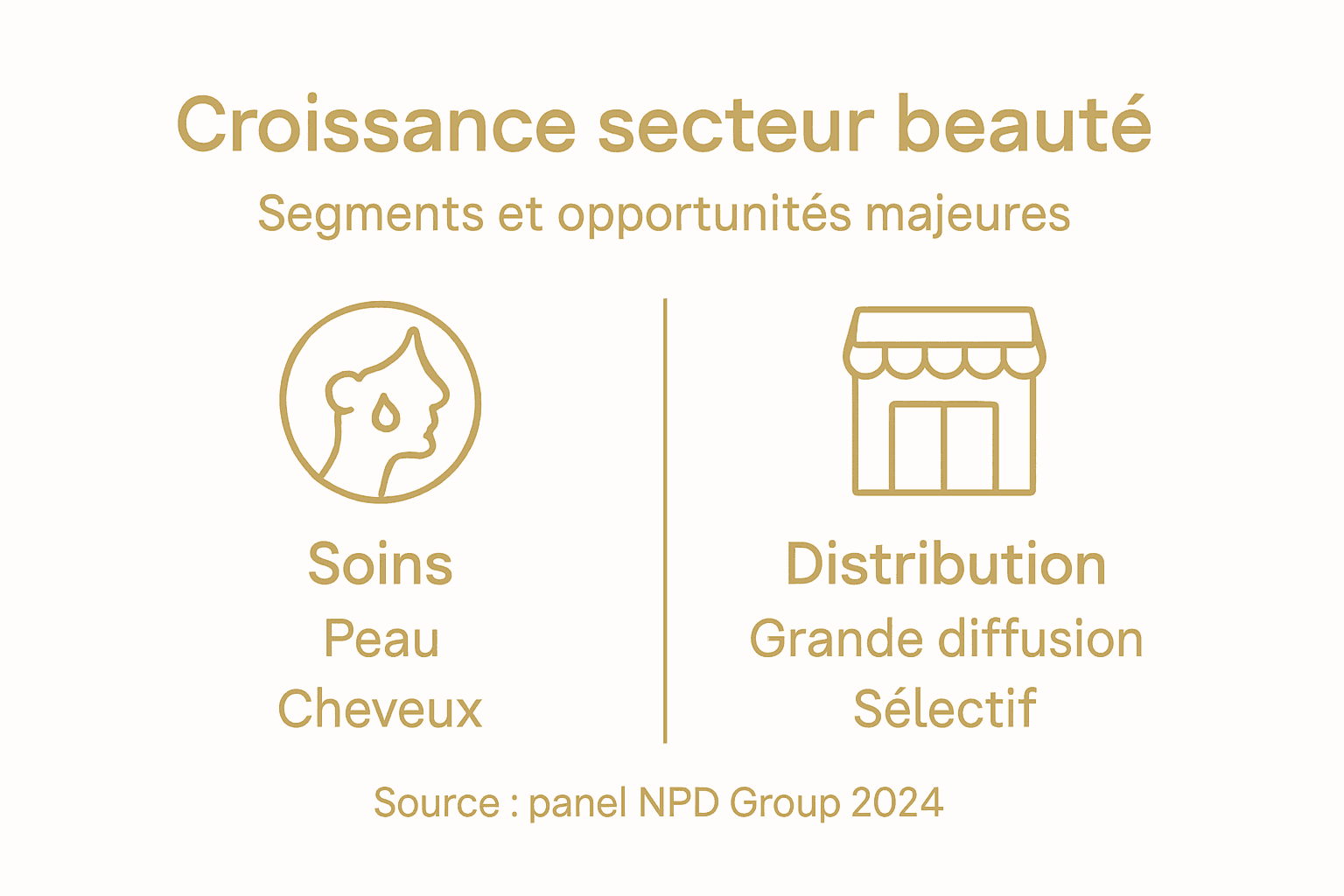
Distribution itself is changing rapidly. Mass-market retail is up 13% while selective retail is declining, meaning premium brands are looking to reach more consumers without sacrificing their prestige. E-commerce now accounts for 20% of beauty sales and continues to grow, making premium products more accessible to French-speaking consumers around the world. To better understand how these segments are taking shape, you can explore Korean beauty and its innovative approaches, a major trend in facial skincare. These dynamics confirm that skincare and hair care offer the best long-term investment prospects, with brands able to justify their prices through ongoing innovation.
Here is a summary of the main segments of the beauty industry and their outlook for 2024:
| Market segment | Market share (%) | Growth trend | Investment opportunity |
|---|---|---|---|
| Skincare | 44 | Strong growth | High innovation, customer loyalty |
| Hair care | 24 | Sustained growth | Emerging technologies |
| Makeup | 17-20 | Slight decline | Careful selection |
| Fragrance | <20 | Stable, prestige-driven | High margins, luxury niche |
| Personal hygiene | - | +14% in 2024 | Strong momentum, organic products |
Pro tip: Focus your beauty investments on growing segments (skincare, personal care, organic products) and favor recognizable brands in e-commerce to maximize access to quality while building a sustainable portfolio.
Criteria for Trust and Innovation
Trust has become the foundation of any smart beauty investment. French-speaking consumers like you are no longer satisfied with vague marketing promises. Brands must rely on tangible evidence rather than marketing rhetoric, which means transparency is no longer optional. When you invest in a reputable brand, that is exactly what you are buying: a company with the confidence to publish its formulas, clinical study results, and certifications. Major brands such as Nu Skin, Eternas, and GESKE have nothing to hide because they cannot afford to. Their reputations are built on decades of investment in research, and they communicate openly about every detail: the ingredients they use, concentrations, efficacy tests, and even the environmental impact of their products. This transparency creates a foundation of trust that protects your investment.
Innovation is the other pillar. A trusted brand never rests on its laurels. It invests continuously in research and development, adapting its formulas to the latest scientific discoveries and consumers’ changing needs. This is particularly evident in at-home skincare devices, where brands such as GESKE and JRL constantly push the boundaries of accessible technology. These authentic companies generate demand by demonstrating that their products really deliver results, with measurable before-and-after results, rigorous dermatological studies, and verifiable customer feedback. Ethics also play a crucial role: an innovative brand today is one that cares about its environmental footprint, the ethical sourcing of its ingredients, and sustainable packaging. This commitment to ingredient quality and environmental responsibility is not just a trend; it has become a key evaluation criterion for conscious investors.

Performance and sustainability now form a new pact between you and the brands you choose. Investing in a reputable beauty brand means believing that it will deliver on its promises year after year, that its formulas will remain effective, that its customer service will resolve your questions, and that the company itself will have the financial and ethical strength to thrive in the long term. Authentic brands do not try to deceive you with nonexistent miracle ingredients or exaggerated claims. Instead, they seek to build lasting relationships based on honesty and results. That is why discerning consumers around the world return to the same brands year after year—not out of habit, but because these brands consistently deliver on their promises.
Pro tip: Before investing in a beauty brand, look for published clinical studies, consult independent dermatologists’ reviews, and check the brand’s transparency about ingredients and the environment on its official website or through reliable sources.
This table compares the trust criteria for choosing a reputable beauty brand:
| Key criterion | Impact on customers | Influence on investment | Current expectation |
|---|---|---|---|
| Transparency | Safer purchases | Reduced risk | Expected, standardized |
| Certifications | Quality assurance | Increases brand value | ISO, official labels |
| Continuous innovation | Lasting results | Competitive advantage | Ongoing research |
| Customer service | Increased loyalty | Relationship maintenance | Generous policies |
Practical Benefits for the Informed Buyer
As an informed buyer, you have access to a world of possibilities that passive consumers completely miss. You benefit from a diverse range of products, including natural, ethical, and innovative options formulated specifically for your skin type and individual needs. Proven efficacy and transparency about ingredients are no longer luxuries; they are standards you can expect from reputable brands. When you invest in Nu Skin, Eternas, or GESKE, you are not buying blindly. You are choosing products that have been rigorously tested, whose ingredients are clearly documented, and whose results can be verified. This knowledge gives you a decisive advantage: you choose safer products because you know exactly what they contain, more effective products because their efficacy has been demonstrated, and products aligned with your values because you can verify each brand’s environmental commitments.
Technological innovation amplifies this advantage. Personalized products that use artificial intelligence and tailored skincare are becoming accessible to informed consumers. At-home skincare devices such as those from GESKE or JRL offer a treatment experience once reserved for spas and dermatology clinics. Brands are investing in personalization because they understand that your skin is not the same as your neighbor’s. As a savvy buyer, you can now access skincare genuinely tailored to your specific needs and based on data rather than generic solutions. This precision means better, faster results, fully justifying your investment.
The third, often underestimated benefit is alignment with your values. Growing demand for personalized, sustainable, and inclusive skincare reflects a fundamental shift in what consumers expect from brands. You are no longer investing in a simple cosmetic product; you are investing in a brand that respects your ethical and environmental principles. Authentic brands understand this. They commit to social and environmental responsibility because they know that customers like you expect them to act consistently with those commitments. This alignment creates satisfaction that goes beyond the product’s effectiveness. You can rest easy knowing your money supports a company that does things the right way.
In practice, informed buyers benefit from a better overall customer experience. Reputable brands invest in customer service, warranties, generous return policies, and consumer education because they aim to build long-term relationships. You get not only a better product, but also a better relationship with the brand you have chosen.
Pro tip: Use official brand websites to access clinical studies, review quality certifications, and check independent dermatologists’ opinions before buying to maximize your beauty ROI.
Risks, Alternatives, and Common Mistakes
Investing in reputable beauty brands involves real risks that every informed buyer should understand. The industry faces intense competition and an increasingly commoditized product range. Low-cost platforms and private-label brands are capturing an ever-larger share of the market, putting downward pressure on prices. This weakens established brands’ position and can quickly erode profit margins. Strained purchasing power means that even consumers loyal to premium brands are more hesitant before investing. There is a real risk that selective brands will lose their appeal if they do not continually justify their prices through innovation and quality. So you need to stay vigilant: a brand that was reputable yesterday is not guaranteed to remain relevant tomorrow if it fails to adapt.
Another major risk concerns volatile macroeconomic conditions. Geopolitical tensions, rising interest rates, and economic uncertainty directly affect brands’ ability to innovate and maintain their quality standards. When a brand has to reduce production costs to remain profitable, quality is often the first thing to suffer. Common mistakes buyers make include underestimating brands’ ability to evolve in an intensely competitive market. Many assume that a major brand will remain successful simply through inertia, when in reality, it must constantly reinvent itself or risk declining.
The alternatives you should resist include false shortcuts. Some consumers think that buying cheaper products from store brands or knockoffs delivers the same results. This is rarely true. Recognized brands justify their prices with decades of research, rigorous dermatological testing, and strict quality control. Cheap alternatives may look similar at first glance, but they often lack this expertise and safety guarantee. Another common mistake is confusing popularity with quality. A highly visible brand is not necessarily the best for your specific skin type. Instead, look for brands recognized by dermatologists and backed by independent clinical studies.
Market fragmentation also poses a risk. With so many small independent brands emerging each year, it is becoming difficult to distinguish genuine innovations from mere marketing trends. Investing in independent brands remains riskier, and valuations are more moderate, which means you have less assurance of their long-term viability. If you choose a small emerging brand over an established one, you are betting on its future success without any certainty. Recognized brands like Nu Skin, Eternas, or GESKE offer greater security precisely because they have already proven their ability to survive and thrive over decades.
Pro tip: Spread your beauty portfolio across 2 or 3 trusted established brands rather than investing heavily in just one, and reassess your brands’ innovation and transparency annually to spot early signs of decline.
Invest with confidence in recognized beauty brands with HBPS-Beauty.com
Would you like to make your beauty purchases with confidence while benefiting from constant innovation and complete transparency about your products? At HBPS-Beauty.com, we understand that quality and reliability are at the heart of your priorities. You are looking for established brands like Nu Skin, Eternas, or GESKE, whose clinical studies and certifications demonstrate their credibility and effectiveness. Our platform offers a wide selection of at-home beauty devices, skincare, and hair care products designed to meet the expectations of discerning consumers who prioritize lasting performance.
Don’t let uncertainty hold back your beauty routine. Discover premium solutions on HBPS-Beauty.com today, selected for their transparency, environmental commitment, and ongoing innovation. Enjoy a user-friendly interface that makes online shopping easy, get personalized advice, and join a community of informed consumers who invest in long-term quality. To learn about our flagship products and understand how to optimize your beauty investment, also explore our complete guide to anti-wrinkle facial routines and let us guide you toward a secure and rewarding beauty experience.
Frequently Asked Questions
What criteria should I use to choose a recognized beauty brand?
The criteria include transparency about ingredients, quality certifications, ongoing innovation, and customer service. A beauty brand should provide tangible evidence of its products’ effectiveness and clearly communicate its manufacturing processes.
How can I verify the authenticity of a beauty brand?
To verify a brand’s authenticity, review its published clinical studies, official certifications, and independent dermatologists’ opinions. A reliable brand discloses its efficacy results and adheres to strict quality standards.
How important is innovation for beauty brands?
Innovation is crucial because it enables brands to adapt to new scientific discoveries and consumer expectations. Brands that invest in research and development often offer more effective and safer products.
What risks should I consider when investing in beauty brands?
The main risks include intense competition that can affect profit margins, as well as economic fluctuations that could impact product innovation and quality. It is also important not to confuse popularity with quality.