

What Is Niche Perfume? A Complete 2026 Guide
TL;DR:
- Niche perfume refers to a house specializing in fragrance creation, with selective distribution and artistic freedom. Quality or price do not automatically guarantee superiority, but rather reflect their business model. It is essential to test on skin, observe the evolution of the olfactory phases, and understand the house's philosophy to choose a perfume that suits you.
A niche perfume is defined as an olfactory creation from a house whose main activity is perfumery, distributed selectively and designed with an artistic freedom that major consumer brands do not afford themselves. The concept of niche perfume is based above all on a business and cultural model, and not on an automatic promise of superior quality. Understanding this distinction radically changes the way you approach the purchase, discovery, and appreciation of a perfume. This guide gives you the keys to distinguish fact from marketing, choose with discernment, and fully enjoy this unique olfactory universe.
What exactly is a niche perfume?
According to Fragrance.link, a niche perfume refers to a model of creation and distribution rather than a specific quality or price. The niche house stands out by the fact that perfumery is its core business, with a limited fragrance portfolio and a commercial presence limited to selective channels. This contrasts directly with so-called designer brands like Hugo Boss or Chanel, which use perfume as an extension of a broader fashion or luxury identity.
The concept of niche perfume also implies a different creative philosophy. Where a major commercial house seeks to appeal to the greatest number, a niche house like Serge Lutens, Diptyque, or Byredo builds a coherent olfactory signature, sometimes unsettling, sometimes highly polarizing. This boldness is precisely what attracts serious perfume enthusiasts.
The Fragrance Foundation France states in 2026 that niche refers above all to a model and not a promise of quality. This point is crucial: a niche perfume can be disappointing, poorly balanced, or simply unsuitable for your skin. The label guarantees nothing in itself.
What are the characteristics of niche perfumes?
Niche perfumes share several distinctive traits, but none are absolute. Here are the most reliable criteria for identifying a niche house:
- Main activity focused on perfumery. The house exists to create perfumes, not to sell bags or clothes. Maison Francis Kurkdjian, Frederic Malle, or Le Labo are representative examples.
- Limited portfolio. A niche house rarely offers more than thirty to fifty references, compared to hundreds for major commercial brands.
- Selective distribution. Niche perfumes are found in concept stores, specialty boutiques, or online on dedicated platforms. They are absent from supermarkets and generalist perfume chains.
- Higher prices. EcoFrenchLab notes that characteristic prices range between €150 and €300 for a 50 to 100 ml bottle. This positioning reflects the cost of quality raw materials and the lack of economies of scale associated with mass production.
- Artistic freedom and experimentation. The Fragrance Foundation France emphasizes that niche claims a stance of freedom, producing heterogeneity in creations. Some niche perfumes are masterpieces; others are polarizing experiences that will only appeal to a minority.
Pro tip: Before buying an expensive niche perfume, always ask for a sample. Most specialty boutiques and online platforms offer discounted samples to test the evolution on your skin before committing.
One often overlooked point: the lack of an automatic guarantee of excellence or longevity. A niche perfume can have poor staying power, an unbalanced composition, or insufficient projection. Creative freedom produces as many failures as successes. This is the accepted downside of this model.
How to distinguish a niche perfume from a conventional perfume?
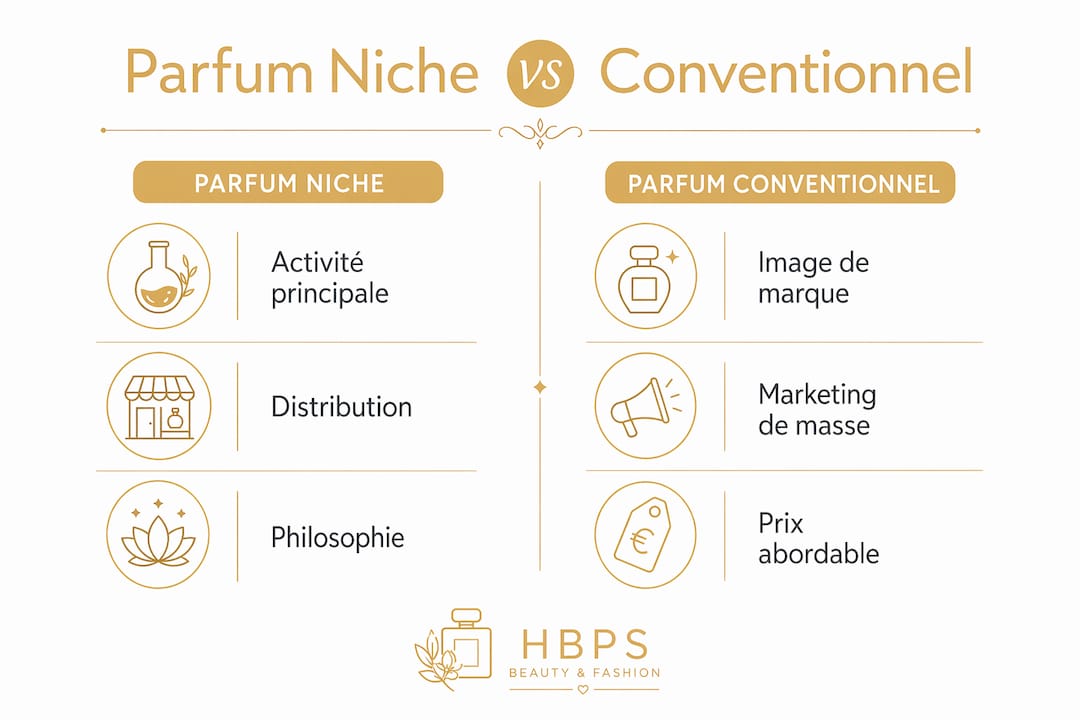
The difference between niche perfume and conventional perfume lies mainly in the brand's philosophy and its distribution channels, much more than in concentration or price alone. Fragrance.link distinguishes three major categories in contemporary perfumery: niche brands, designer brands, and indie (independent) brands. Each follows a different logic.
Designer brands like Dior, Armani, or Hugo Boss use perfume to reinforce an overall brand image. Their goal is maximum diffusion, with formulas designed to appeal to the greatest number. Indie brands are often independent creators without an established commercial infrastructure, sometimes closer to craftsmanship than niche in the strict sense.
Here is a comparison table of the key criteria:
| Criterion | Niche perfume | Conventional perfume |
|---|---|---|
| Brand's main activity | Exclusive perfumery | Fashion, luxury, cosmetics |
| Portfolio size | Limited (10 to 50 references) | Large (50 to several hundred) |
| Distribution | Selective, specialty boutiques | Mass market, chains |
| Creative intention | Artistic, experimental | General public, consensual |
| Price range | €150 to €300 / 50 to 100 ml | €40 to €120 / 50 to 100 ml |
| Quality guarantee | None automatically | None automatically |
One criterion often wrongly cited as determining is concentration. A niche perfume can very well be a light Eau de Toilette, while a mainstream perfume can be offered as an Extrait de Parfum. Concentration is not a marker of niche. To delve deeper into the question of quality and distinction in high-end perfumery, the high-end perfume guide by Hbps-beauty offers useful benchmarks.
What is the importance of concentration in a niche perfume?
The aromatic concentration of a perfume measures the proportion of olfactory raw materials in the final mixture. The usual ranges, according to Luxsure, are as follows:
| Concentration | Proportion of olfactory materials | Average longevity |
|---|---|---|
| Eau de Cologne (EdC) | 2 to 5% | 2 to 3 hours |
| Eau de Toilette (EdT) | 5 to 15% | 3 to 5 hours |
| Eau de Parfum (EdP) | 15 to 20% | 5 to 8 hours |
| Extrait de Parfum | 20 to 40% | 8 hours and more |
These figures provide a framework, but they do not tell the whole story. Luxsure reminds in 2026 that the volatility of the notes is crucial for the actual perceived longevity. A perfume built mainly on top notes like citrus or fresh herbs will evaporate quickly, regardless of its concentration. Conversely, a perfume rich in base notes like sandalwood, musk, or vanilla will last several hours even as an Eau de Toilette.
The historic 4711 Eau de Cologne perfectly illustrates this point: despite having one of the lowest concentrations on the market, it remains a model of balance and olfactory coherence recognized for centuries. Concentration is therefore not an absolute indicator of quality.
Pro tip: To choose your concentration, take into account your skin type (dry skin holds perfumes less), the context of use (office, evening, sports), and your personal sensitivity to raw materials. A well-constructed Eau de Toilette can outperform a poorly formulated Extrait.
How to choose and appreciate a niche perfume?
Choosing a niche perfume requires a different approach from the one you would adopt for a mainstream perfume. Here is a five-step method to guide your discovery:
- Test on skin, never solely on paper. The evolution of a perfume on your skin depends on your pH, your diet, and your body heat. What smells good on a blotter can be disappointing on you, and vice versa.
- Observe the three olfactory phases. The top notes (the first few minutes), the heart notes (30 minutes to 2 hours), and the base notes (several hours) define the complete experience. A niche perfume is judged on its coherence throughout this evolution.
- Read the artistic intention of the house. Byredo builds abstract emotional narratives. Serge Lutens explores oriental and powdery olfactory territories. Maison Francis Kurkdjian aims for contemporary elegance. Understanding the philosophy of a house helps you anticipate whether its universe matches yours.
- Adapt the choice to the context. A niche perfume loaded with oud or resin is not suitable for an office environment. An aquatic or light floral perfume will be more suitable for daily use in summer. The context of use is a filter as important as your personal preferences.
- Use olfactory benchmarks rather than brands. If you like woody and smoky perfumes, explore the corresponding aromatic families at several niche houses. The Fragrance Foundation France recommends prioritizing olfactory coherence and personal signature rather than the label alone.
A warning is necessary: beware of niche perfumes bought solely on reputation or online reviews. Olfaction is the most subjective sense there is. What is unanimously praised on specialized forums may leave you completely indifferent. Personal experience always trumps collective consensus.
Key points
A niche perfume is defined above all by its business model and distribution philosophy, not by a guaranteed intrinsic quality or a specific concentration.
| Point | Details |
|---|---|
| Definition of niche perfume | House focused on perfumery, limited portfolio, and selective distribution. |
| No automatic guarantee | The niche label certifies neither the quality nor the longevity of a perfume. |
| Concentration and longevity | The nature of the notes (volatile or fixing) influences longevity as much as concentration. |
| Difference with conventional | Brand philosophy and distribution distinguish niche and designer, not price alone. |
| Selection method | Test on skin, observe the three phases, and read the artistic intention of the house. |
What I learned about the real value of niche perfumes
The term niche is today one of the most overused words in perfumery. Brands launched two years ago with three references and a polished Instagram account claim to be niche with as much confidence as Serge Lutens or Annick Goutal, who built their identity over decades of rigorous creation. This inflation of the term should make you vigilant.
What I concretely observe: the creative freedom of niche produces the most fascinating perfumes on the market, but also some of the most disappointing. A perfume like Ambre Sultan by Serge Lutens or Portrait of a Lady by Frederic Malle fully justifies its positioning through the depth of its composition and the coherence of its universe. Others, sold at an equivalent price, are merely marketing constructions dressed in a minimalist bottle.
My most direct advice: ignore the word niche as a purchase criterion. Focus on the house, its history, the coherence of its portfolio, and, above all, on what the perfume does on your skin after two hours. Niche as a space of olfactory diversity and innovation deserves your curiosity. Niche as a sales argument deserves your skepticism.
— JSCC
Enhance your beauty routine with Hbps-beauty

The niche perfume universe is part of a global approach to care and well-being. At Hbps-beauty, this philosophy is reflected in a selection of products designed to enhance your beauty from the inside out. The Pharmanex Lifestyle Essentials supplements support your daily balance, while the Beauty Focus MultiBeauty skincare products target cellular beauty for visible results. Because a niche perfume deserves skin and a body in top shape to express itself fully, Hbps-beauty accompanies you at every step of your routine.
FAQ
What defines a niche perfume?
A niche perfume is defined by a house whose main activity is perfumery, with selective distribution and increased artistic freedom. This business and cultural model does not automatically guarantee superior quality.
What is the difference between niche perfume and designer perfume?
The main difference lies in the brand philosophy and distribution. A designer brand like Dior or Armani uses perfume as an extension of a fashion identity, while a niche house centers all its activity on fragrance creation.
Do niche perfumes last longer than classic perfumes?
Not necessarily. Longevity depends more on the nature of the notes used than on concentration or niche positioning. A perfume rich in base notes like musk or wood will last a long time, whether it is niche or mainstream.
What is the average price of a niche perfume?
Niche perfumes generally range between €150 and €300 for a 50 to 100 ml bottle, according to EcoFrenchLab. This positioning reflects the cost of raw materials and the lack of mass production.
How to test a niche perfume before buying it?
Always test on skin and observe the evolution for at least two hours to perceive the three olfactory phases. Many specialty boutiques and online platforms offer samples to avoid unpleasant surprises at purchase.