

Chemical peel: definition, types and procedure explained
A chemical peel is the controlled application of an acid to the skin that triggers intentional exfoliation, causing damaged layers to shed and make way for new skin. It is an aesthetic medicine procedure that has existed for decades, and its principle remains simple despite the variety of products used today.
Three elements are enough to understand the essentials of the treatment:
- The depth of action varies: a peel acts on the epidermis (superficial), the papillary dermis (medium), or the reticular dermis (deep), depending on the acid and its concentration.
- The objective remains twofold: to exfoliate dead cells and stimulate collagen production to improve texture, radiance, and firmness.
- Peeling is part of the process, not a side effect to fear: the skin peels because it is renewing itself.
The social downtime periods logically follow this depth. Allow 1 to 3 days for a superficial peel, 7 to 10 days for a medium peel, and 2 to 4 weeks for a deep peel.
Table of Contents
- How does a chemical peel work?
- What are the different types of chemical peels?
- Who is a chemical peel for?
- How does a peel session go?
- What are the side effects and contraindications of a peel?
- What to do and what to avoid after a chemical peel?
- What to expect: timeline and effectiveness of results
- How much does a chemical peel cost and how long does the effect last?
- How to choose your practitioner for a chemical peel?
- Chemical peel, laser, or microdermabrasion: what's the difference?
- Maintaining your skin between two peels with the right products
- Key points to remember about chemical peels
- Sources
How does a chemical peel work?
The mechanism is based on simple chemistry: an acid dissolves the bonds that hold dead cells on the surface, which accelerates skin renewal that would normally take several weeks. The most common acid families are AHAs (glycolic acid, lactic acid), BHAs (salicylic acid), TCA (trichloroacetic acid), and, for the most severe cases, phenol.
Each family acts differently. AHAs work on the surface and are suitable for sensitive skin or first-time peel experiences. TCA penetrates deeper and targets the papillary dermis, which explains why it is used for acne scars and more pronounced dark spots. Phenol, reserved for deep peels, reaches the reticular dermis and causes a much more intense reaction.
It is important to be honest about this: a medium or deep peel causes a real controlled chemical burn. It is not a gentle exfoliation like a mechanical scrub. The skin reacts as if it were a thermal injury, with redness, heat, and, for deep peels, peeling sometimes compared to that of a second-degree burn. This controlled reaction in turn triggers a cascade of regeneration: fibroblasts are activated, collagen production increases, and skin texture gradually improves over several weeks.
- The acid destroys damaged superficial cells.
- The skin triggers a repair mechanism that stimulates collagen.
- The visible result (radiance, uniformity, firmness) appears after the healing phase, not immediately.
Pro tip: Never confuse a chemical peel with a classic mechanical exfoliation. A scrub acts on the surface without triggering a deep cellular reaction, while a peel, even superficial, actively changes the skin's renewal cycle.
What are the different types of chemical peels?
The depth of action depends on three factors: the nature of the acid, its concentration, and the contact time. These three variables determine how far the chemical agent penetrates into the skin, and therefore what type of problem it can treat.
The superficial peel remains in the epidermis. It generally uses low-concentration AHAs or salicylic acid, and is suitable for a dull complexion, enlarged pores, or small imperfections. The medium peel goes down to the papillary dermis, often based on TCA, and tackles fine lines, more established dark spots, and superficial acne scars. The deep peel, reserved for phenol, reaches the reticular dermis. It is a major medical procedure, performed exclusively in a clinical setting, which treats severe photoaging or deep wrinkles.
| Peel type | Depth reached | Typical indications | Recovery | Typical sessions |
|---|---|---|---|---|
| Superficial | Epidermis | Dull complexion, enlarged pores, small imperfections | 1 to 3 days | 4 to 6 sessions |
| Medium | Papillary dermis | Fine lines, dark spots, acne scars | 7 to 10 days | 1 to 3 sessions |
| Deep | Reticular dermis | Severe photoaging, marked wrinkles | 2 to 4 weeks | Single or rare procedure |
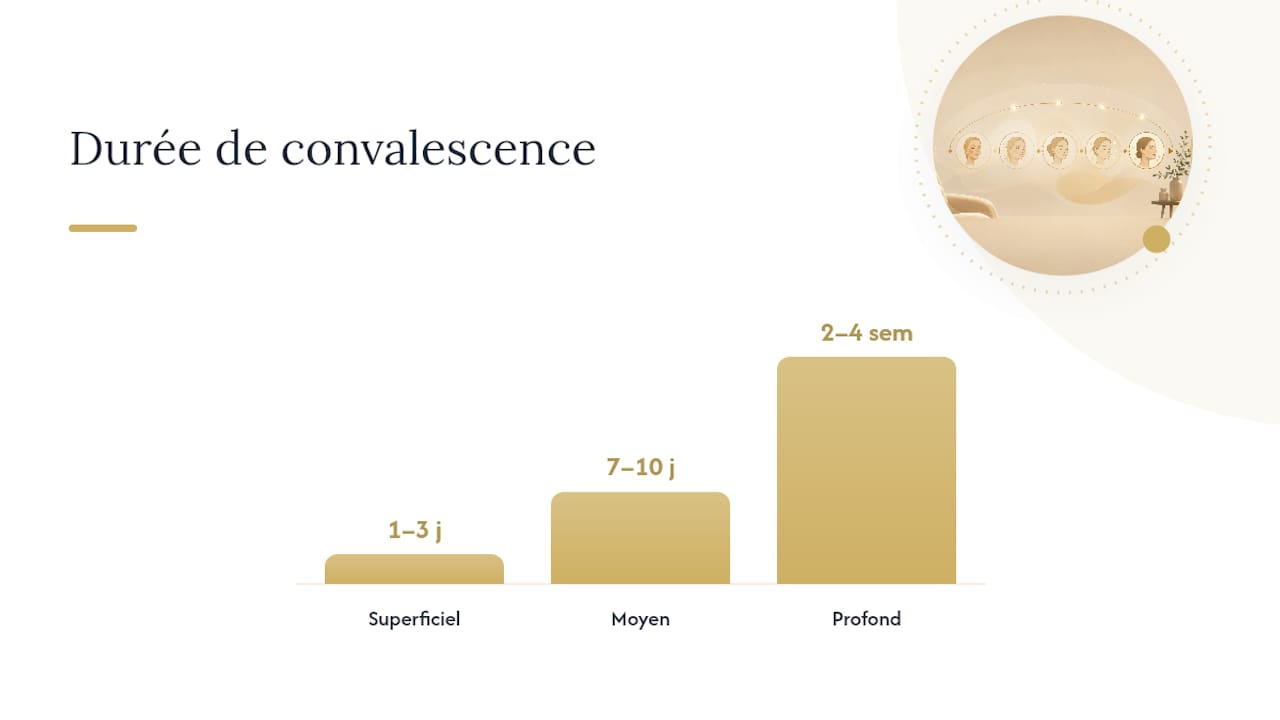
One point deserves clarification: the deeper the peel, the less frequently it is repeated. A superficial peel is performed in close succession because its action is gentle; a deep peel, conversely, produces a lasting result in a single intervention, but at the cost of a much heavier recovery.
Who is a chemical peel for?
A chemical peel responds to precise indications, validated by dermatological practice. It is not a universal procedure: some skin problems respond well to it, others not at all.
The most common indications include dull complexion, fine lines, dark spots, acne scars, and photoaging. These cases concern a majority of requests in the office, and the results have been documented for a long time.
- A dull or tired complexion, often linked to an accumulation of dead cells.
- Superficial fine lines and the first signs of photoaging.
- Dark spots (mild melasma, sun spots).
- Acne scars and an uneven skin texture.
- Enlarged pores associated with excess sebum, common on oily skin.
However, chemical peels have their limits. Vascular problems such as couperose or rosacea derive no benefit from them, and some aggressive acids can even worsen these conditions by further irritating already weakened vessels. If your main concern is diffuse redness or visible vessels, a peel is probably not the right answer, and a dermatological opinion is required before any decision.
How does a peel session go?
A chemical peel is performed in four steps: preparation, application, healing, and maintenance. Each of these phases conditions the final result, and neglecting preparation remains one of the main causes of post-inflammatory hyperpigmentation.
- Skin preparation: several weeks before the session, the practitioner often recommends using low-dose retinol, gentle AHAs, or depigmenting agents, depending on your skin type and the targeted objective.
- Skin cleansing: on the day of the session, the skin is cleansed and degreased to allow a homogeneous penetration of the acid.
- Product application: the acid is applied in successive layers on the face, avoiding sensitive areas such as the eyelids.
- Contact time: depending on the type of peel, it varies from a few minutes to about twenty minutes, with constant monitoring of skin reactions.
- Neutralization or rinsing: for AHAs and TCA, neutralization with water or an alkaline solution stops the action of the acid at the desired time.
A session lasts on average between 20 and 45 minutes, preparation included. Some practitioners offer a fan or a cold compress to alleviate discomfort during application.
Pro tip: Never plan a medium or deep peel just before an important event. Even allowing plenty of time on the recovery timeline, the skin can remain slightly pink several days after the official end of peeling.
What are the side effects and contraindications of a peel?
Recovery follows a direct logic: the deeper the peel penetrates, the longer the healing phase. A superficial peel causes slight peeling for 1 to 3 days, similar to a peeling sunburn. A medium peel causes redness, swelling, and more visible peeling over 7 to 10 days. A deep peel, meanwhile, is accompanied by marked edema, scabs, and a healing phase that can extend over 2 to 4 weeks, with residual redness that sometimes persists for several months.
Frequent side effects remain mild: redness, a pulling sensation, peeling, slight tingling. Rarer complications, however, deserve your attention.
- Post-inflammatory hyperpigmentation: more frequent in poorly prepared medium-toned skin beforehand.
- Skin infection: increased risk in case of non-compliance with post-peel hygiene instructions.
- Scars: rare but possible, especially with a poorly supervised deep peel or a predisposed skin.
- Allergic reaction to one of the components of the formula used.
Certain situations totally contraindicate chemical peels: pregnancy and breastfeeding, an active atopic skin, the recent intake of photosensitizing treatments or isotretinoin, and a history of pathological healing (keloids). This last point deserves the same vigilance regardless of the level of peel considered: a superficial peel poorly tolerated on skin at risk of keloid can cause as much trouble as a poorly prepared deep peel.
This article provides general information and does not replace a personalized medical consultation. Always check the contraindications specific to your situation with a qualified healthcare professional.
What to do and what to avoid after a chemical peel?
Post-peel care largely determines the quality of the final result, even more than the choice of the acid itself. Skin that has just undergone a controlled exfoliation is temporarily more fragile and more permeable, which changes the rules for a few days to a few weeks.
- Hydrate intensely with repair creams adapted to weakened skin.
- Apply a high SPF sunscreen every morning, without exception, even in cloudy weather.
- Avoid heavy makeup as long as peeling is not finished.
- Ban retinoids, acids, and mechanical exfoliants during the entire healing phase.
- Never scratch scabs or peeling skin, even if the temptation is strong.
Sun exposure remains the number one enemy after a peel: skin that has just renewed itself is much more sensitive to UV rays, and unprotected exposure can cancel out part of the benefits of the treatment by causing irregular pigmentation.
- Consult quickly if you notice redness that intensifies instead of decreasing after several days.
- Contact your practitioner in case of oozing, unusual pain, or fever.
- Report any appearance of dark spots that spread rather than fade, a possible sign of hyperpigmentation.
What to expect: timeline and effectiveness of results
The first effects of a superficial peel generally appear a few days after the session, once peeling is finished. For medium and deep peels, the definitive result takes shape over several weeks, the time it takes for collagen to reorganize deep down.
The number of sessions required depends directly on the type chosen. A superficial peel generally requires 4 to 6 sessions spaced 2 to 3 weeks apart to obtain a visible cumulative result on the complexion and texture. A medium peel is often limited to 1 to 3 sessions spaced several weeks to a few months apart. A deep peel, due to its intensity, remains a rare procedure, sometimes performed only once in a lifetime.
Regarding concrete effectiveness, some clinical studies report a reduction of dark spots by 50 to 80% with superficial to medium peels, a figure that varies depending on the type of spot treated and the regularity of the protocol. However, expectations must remain realistic: peeling gradually improves the appearance of the skin, it does not instantly erase years of accumulated sun damage.
- The complexion gains radiance from the first sessions for a superficial peel.
- Acne scars gradually fade, rarely spectacularly in one go.
- Deep wrinkles require a medium or deep peel for a truly visible change.
How much does a chemical peel cost and how long does the effect last?
A superficial peel performed by a qualified aesthetician generally costs less than a medium peel performed by a dermatologist, itself considerably less expensive than a deep peel performed in a clinic with reinforced medical supervision.
These price differences make any universal estimate misleading. The only reliable approach remains to ask for a personalized quote after a consultation, where the practitioner evaluates your skin, defines the appropriate protocol, and communicates a precise price for your case.
- A superficial peel is generally maintained by regular treatments, several times a year.
- A medium peel produces a result that lasts several months to a year depending on home maintenance care.
- A deep peel offers the most lasting effect, sometimes several years, in exchange for a heavy recovery.
Between two peels, less invasive treatments allow you to maintain the results: a gentle home exfoliation, a targeted moisturizing routine, and rigorous daily sun protection limit the gradual regression of the effect.
How to choose your practitioner for a chemical peel?
The practitioner's choice directly affects the safety and effectiveness of the treatment. A superficial peel can be performed by a trained aesthetician, but a medium or deep peel must always be entrusted to a qualified dermatologist or medical aesthetician capable of managing a complication if one occurs.
Before committing, ask these questions during your consultation:
- How many years have you been specifically performing this type of peel?
- What skin preparation protocol do you recommend before the session?
- How do you manage a complication such as hyperpigmentation or infection?
- Can I see examples of results on skin similar to mine?
The success of a peel depends on three pillars: a qualified practitioner, strict adherence to the pre- and post-session protocol, and consistency to assess results over several sessions rather than just one. Be wary of a practitioner who downplays contraindications, does not ask about your medical history before the procedure, or offers a deep peel without a thorough preliminary consultation. These warning signs often indicate insufficiently rigorous care.
Chemical peel, laser, or microdermabrasion: what's the difference?
A chemical peel is not the only option for rejuvenating the skin or treating pigmented spots, and it is worth comparing it to the most common alternatives.
Laser targets specific concerns with great precision, particularly well-defined pigmented spots or certain dilated blood vessels, whereas a peel works more broadly on the entire face. For skin rejuvenation focused on firmness and radiance, laser often offers a more predictable recovery than some medium peels.
Microdermabrasion, for its part, remains a superficial mechanical technique, without a chemical reaction or deep collagen stimulation. It is suitable for light and regular maintenance, but it never reaches the depth of a medium or deep peel.
- A chemical peel is often more affordable than an equivalent laser treatment in terms of the number of sessions.
- It can be adjusted by depth, allowing the intensity to be tailored to your tolerance and goals.
- Laser is better suited for highly localized vascular or pigmented concerns, where a peel remains ineffective or even contraindicated.
- Microdermabrasion complements a peel protocol during the maintenance phase, between two more intense sessions.
A transformation built session by session
The main misconception about chemical peels is to imagine them as a one-off procedure that instantly erases years of skin damage. That is not how the skin works. Practitioners describe a peel as a tool for gradual transformation, where each session builds on the previous one rather than producing an isolated result.
This reality should change the way you approach preparation. Too many people focus solely on the session itself and neglect the weeks leading up to it, even though that is precisely when a large part of the result is determined. Skin that is well prepared, with suitable active ingredients introduced gradually, tolerates the acid better and heals with fewer complications.
For medium and deep peels, caution is not an option, it is a necessity. These procedures alter the structure of the dermis, and an error in dosage, application time, or post-treatment follow-up can leave lasting scars. A superficial peel can tolerate an error; a deep peel forgives almost nothing. It is this asymmetry that should guide your choice of practitioner as much as your choice of protocol.
Maintaining your skin between two peels with the right products
At-home care never replaces a peel performed in a clinic or medical office, but it prolongs its benefits and prepares the skin for the next session. This is where Hbps-beauty comes in: between two appointments with your practitioner, the right routine limits the regression of results and reduces the risk of complications.

The store offers gentle exfoliants with a low concentration of AHAs, suitable for regular use without irritating skin that has just undergone a more intense treatment. The repairing moisturizing products in the Hbps-beauty selection help restore the skin barrier during the healing phase, and high SPF sunscreens remain essential to preserve the results achieved, regardless of the type of peel performed. To learn more about how chemical exfoliants work daily, the complete resource is available. Remember, however, that a professional diagnosis remains essential before any medium or deep peel. Discover the full selection on the Hbps-beauty store to create a maintenance routine tailored to your skin.
Key points to remember about chemical peels
A chemical peel consists of a controlled exfoliation whose depth—superficial, medium, or deep—determines both the conditions it can treat and the necessary recovery time.
| Point | Details |
|---|---|
| Definition | Application of an acid that exfoliates the skin and stimulates cell renewal. |
| Three levels | Superficial (epidermis), medium (papillary dermis), deep (reticular dermis). |
| Crucial preparation | Preparatory care several weeks beforehand reduces the risk of hyperpigmentation. |
| Precautions | Pregnancy, atopic skin, recent isotretinoin use, and a history of keloids are contraindications. |
| At-home care | Hbps-beauty offers gentle, repairing exfoliants and sunscreens to prolong results. |
Sources
- Mayo Clinic — Chemical peel
- American Academy of Dermatology — Chemical peels overview
- EM Consulte — Chemical peels and management of skin aging
- Esthétique et Laser — Chemical peel: types, benefits, and precautions
- RQASF — Chemical peel (aesthetic procedure)
Recommendation
- How a chemical exfoliant works: complete 2026 guide – HBPS Beauty & Fashion
- Regular exfoliation: benefits and practical 2026 guide – HBPS Beauty & Fashion
- How hair removal works: complete guide – HBPS Beauty & Fashion
- The steps of effective makeup removal according to your skin – HBPS Beauty & Fashion