

Micellar water: what is it and how to choose?
Micellar water is an aqueous cleansing solution containing micelles—tiny aggregates of surfactant molecules—capable of capturing makeup, sebum, and impurities in a single step, without soap or mandatory rinsing. Present in French bathrooms since the early 1990s, it has established itself as one of the most versatile cleansers on the market, according to Futura-Sciences.
Three key points to remember right away:
- It cleanses and removes makeup in a single pass, without irritating the skin.
- Rinsing is optional for tolerant skin, but recommended for sensitive skin.
- The formula must be chosen according to your skin type: what is suitable for oily skin may irritate atopic skin.
Key Points
Micellar water is a gentle cleanser based on micelles that removes makeup without soap, suits most skin types, and fits into a balanced routine.
| Point | Details |
|---|---|
| Essential definition | Aqueous micellar solution that captures makeup, sebum, and impurities without soap or mandatory rinsing. |
| Correct technique | A well-soaked cotton pad, gliding without rubbing from the inside out, never vigorous rubbing. |
| Rinsing according to skin type | Optional for tolerant skin; recommended for sensitive, atopic skin, or skin undergoing topical treatment. |
| Ingredients to avoid | SLS/SLES, denatured alcohol high on the list, synthetic fragrances—irritants with frequent use. |
| Hbps-beauty | Offers a selection of facial care products and a skin diagnostic tool to choose the right formula. |
Table of Contents
- What exactly is micellar water?
- How do micelles work on your skin?
- What are the real benefits, and what are the limitations?
- Which formula to choose according to your skin type?
- How to use micellar water correctly?
- Micellar water, toner, or another cleanser: which to choose?
- How to read a label and choose the right formula?
- When to stop and consult a professional?
- What do dermatologists say about micellar water?
- A well-chosen micellar water really makes a difference
- Hbps-beauty: find your suitable micellar water in a few clicks
- Sources
What exactly is micellar water?
Micellar water is an aqueous solution in which amphiphilic surfactants spontaneously organize into spherical structures called micelles. Each surfactant molecule has a hydrophilic head (attracted by water) and a lipophilic tail (attracted by fats). In solution, the tails group together toward the inside of the sphere to avoid water, while the heads remain facing outward. Result: a structure capable of trapping oily substances inside while remaining dispersed in water.
It is not a lotion, nor a gel, nor a milk. It is water enriched with these aggregates invisible to the naked eye, generally at physiological pH, without foam and without mandatory rinsing. Its light texture distinguishes it from other cleansers and explains why it is so well tolerated by the majority of skin types.
How do micelles work on your skin?
The mechanism is more elegant than it seems. According to Wikipedia, micelles form beyond a threshold concentration called the critical micelle concentration (CMC or CAC). Below this threshold, surfactants remain individually dispersed in the solution and have no particular cleansing power.
Here is what actually happens during application:
- Attraction: the lipophilic core of each micelle is attracted by the oily substances present on the skin (sebum, foundation, sunscreen).
- Encapsulation: micelles surround the makeup and impurity particles, trapping them in their core.
- Transfer: the cotton pad soaked in micellar water picks up these micelles loaded with impurities, removing them from the skin surface.
This process, detailed by BIODERMA, requires no vigorous rubbing. Physics does the work.
Pro tip: Generously soak the cotton pad before applying it. A cotton pad that is too dry mechanically rubs the skin instead of letting the micelles work—this is the most common mistake.
What are the real benefits, and what are the limitations?
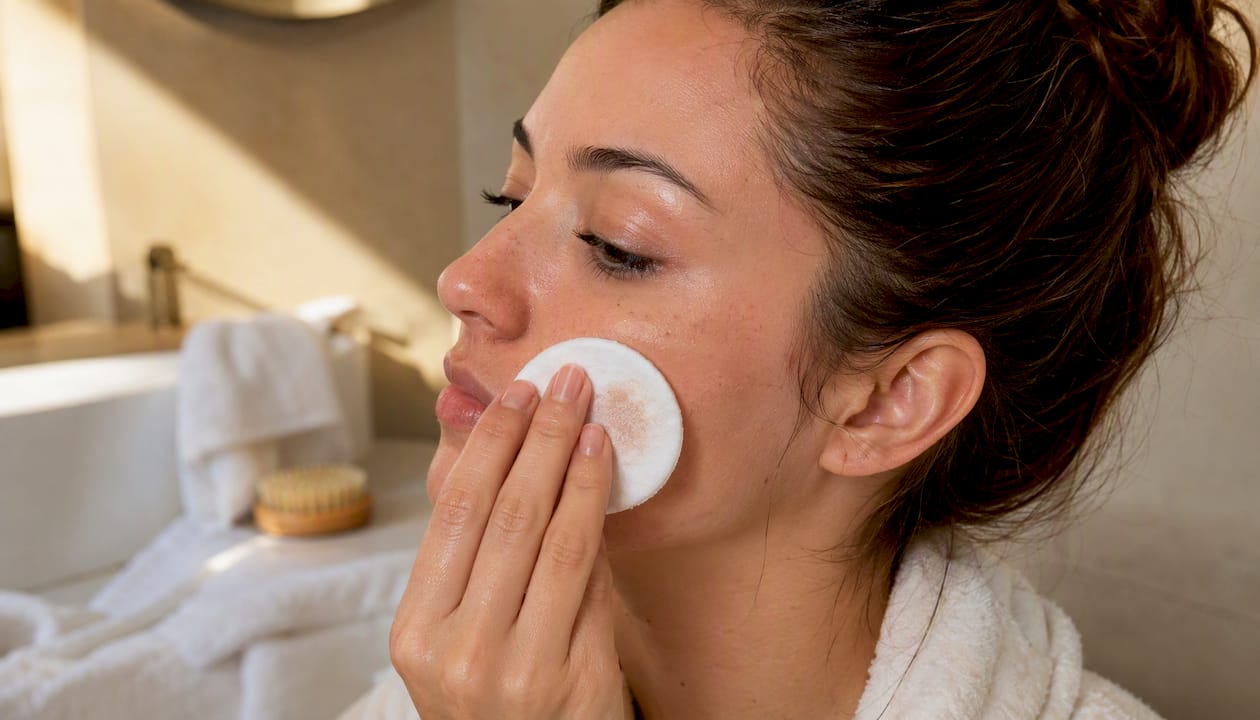
The benefits are real and well documented. A well-formulated micellar water cleanses without stripping, respects the hydrolipidic film, and suits almost all skin types. It contains no soap in formulas adapted for sensitive skin, which avoids the typical "tightness" effect of foaming cleansers. Its speed of use also makes it the ideal product for busy mornings or travel.
Limitations exist, and it is better to know them. Santé Magazine clearly reminds us: micellar water effectively cleanses light makeup and daily impurities, but may prove insufficient for waterproof textures or very full-coverage foundations. In these cases, double cleansing is necessary—an oil or makeup balm on the first pass, followed by micellar water.
Doctissimo also highlights that excessive use or an unsuitable formula can weaken the skin barrier: tightness, redness, and small imperfections may appear if surfactant residues are not removed.
Pro tip: Micellar water is not an isolated step. Always finish with a moisturizer adapted to your skin to compensate for the slight cleansing action on the skin film.
Which formula to choose according to your skin type?
Not all micellar waters are equal, and skin type radically changes what you need to look for on the label.
| Skin type | What to prioritize | What to avoid |
|---|---|---|
| Sensitive / atopic | Fragrance-free, alcohol-free, paraben-free, physiological pH | SLS/SLES, aggressive preservatives, synthetic fragrances |
| Dry | Glycerin, soothing agents (allantoin, panthenol) | Denatured alcohol, sulfate surfactants |
| Oily / combination | Light formula, oil-free, zinc or niacinamide | Formulas that are too rich or occlusive |
| Acne-prone | Non-comedogenic, non-occlusive, dermatologically tested formula | Mineral oils, fragrances, irritating alcohol |
| Eye area | Ophthalmologically tested formula, without irritating preservatives | Any formula not tested on the eyes |
For sensitive skin, BIODERMA France recommends formulas without alcohol or parabens, at physiological pH and based on purified water. These criteria are not marketing: they truly condition skin tolerance.
The question of rinsing depends on your skin, not the brand. If you feel a slight film or a sensation of discomfort after application, rinse with clear water or apply a soothing thermal mist.
Pro tip: For very sensitive skin or skin undergoing treatment (retinoids, acids), always rinse after micellar water to remove any surfactant residue. A soothing mist is enough if you do not want to wet your face.
How to use micellar water correctly?
The method is simple, but the details change everything.
- Generously soak a cotton pad with micellar water—it should be damp, not dripping.
- Place the cotton pad on the area to cleanse (eyes closed for the eyes) and hold for a few seconds to let the micelles work.
- Gently glide from the inside out of the face, without rubbing. One slow pass is better than three quick passes.
- Repeat the operation with a clean cotton pad if the first one comes back very loaded with makeup.
- Finish with a moisturizer adapted to your skin, as recommended by Products PCC.
Rinsing remains optional for tolerant skin, but if you use micellar water in the evening on full makeup, rinsing with lukewarm water or a thermal mist is a reasonable precaution. For a complete skincare routine, micellar water occupies the first step of cleansing.
Micellar water, toner, or another cleanser: which to choose?
These products do not have the same role, and confusing them often leads to ineffective routines.
| Need | Suitable product | Why |
|---|---|---|
| Light daily makeup removal | Micellar water | Cleanses and removes makeup in one step, without mandatory rinsing |
| Skin preparation after cleansing | Toner | Rebalances pH, prepares the skin for subsequent care |
| Waterproof or very full-coverage makeup | Oil / balm + micellar water | Double cleansing necessary to remove resistant pigments |
| Deep cleansing (pores) | Cleansing gel or foam | Foam and rinsing for a deeper action |
| Travel / sports / quick touch-up | Micellar water | Practical, no-rinse, portable format |
Toner is not a cleanser: it comes after cleansing to refine skin texture and prepare for the absorption of care products. Micellar water, on the other hand, is the cleanser. Using them in the correct order—micellar water first, toner next—optimizes both steps.
How to read a label and choose the right formula?
Some concrete pointers so you do not get lost in the aisle or online.
To prioritize:
- Glycerin (hydration and tolerance)
- Allantoin or panthenol (soothing agents)
- Mention "fragrance-free" or "unscented"
- Labels "hypoallergenic" and "dermatologically tested"
- Physiological pH (between 4.5 and 5.5)
To avoid:
- SLS (sodium lauryl sulfate) and SLES: irritating sulfate surfactants with frequent use, according to the Revue Médecine
- Denatured alcohol (alcohol denat.) high on the ingredients list
- Synthetic fragrances or untested essential oils
- Large amounts of PEG for very sensitive skin
The "dermatologically tested" label means that the product has been subjected to skin tolerance tests. It is a minimum guarantee, not a promise of efficacy. To go further in choosing your care products, consult this guide on moisturizing active ingredients.
Pro tip: Ingredients are listed in descending order of concentration. If alcohol or a fragrance appears in the first five, pass it by, whatever the marketing promise.
When to stop and consult a professional?
Micellar water is generally well tolerated, but certain signals require you to stop use immediately.
- Persistent redness after each application, even with rinsing.
- Burning or stinging that does not disappear within a few seconds.
- Unusual acne flare-up or appearance of small pimples after introducing the product.
- Dryness or tightness that worsens despite hydration.
- Allergic reaction: swelling, intense itching, patches.
If any of these signs appear, stop the product, rinse abundantly with lukewarm water, apply a fragrance-free soothing cream, and consult a dermatologist or pharmacist. Atopic skin and people undergoing topical treatment (retinoids, acids) are particularly exposed and must choose their formula with the advice of a healthcare professional.
What do dermatologists say about micellar water?
The dermatological consensus is nuanced, and that is precisely what makes it useful. Biomimetic formulas, designed to imitate the structure of the hydrolipidic film, are recognized as particularly suitable for reactive skin. BIODERMA explains that micelles can respect this protective film if the formula is well designed—which is not the case for all products on the market.
Micellar water is therefore not a panacea. It excels in its role as a gentle daily cleanser, but a skincare routine for glowing skin cannot rely on it alone.
A well-chosen micellar water really makes a difference
What strikes me, after synthesizing all this information, is how micellar water is both overestimated and underutilized. Overestimated because many use it alone to cleanse everything, including waterproof mascara, and are then surprised to have residues or irritation. Underutilized because those who had a bad experience with an unsuitable formula give up on the product entirely rather than looking for the formula that suits them.
The truth is that micellar water is a tool, not a universal solution. Used correctly—with the right product, the right technique, and a moisturizing care as a finishing touch—it truly simplifies the routine without compromising skin health. For sensitive skin in particular, it is often the best entry point into a cleansing routine, provided you rinse and choose a formula without fragrance or alcohol.
Hbps-beauty: find your suitable micellar water in a few clicks
Choosing a micellar water suited to your skin type takes time when you don't know what to look for on the label. Hbps-beauty selects skincare products from renowned brands, available directly online, with detailed product pages to compare formulas without getting overwhelmed.

To learn more about your skin before buying, the Perfect Beauty skin and hair diagnostic camera available on Hbps-beauty allows you to analyze your skin type in detail from home — a practical starting point for choosing the right formula. Visit Hbps-beauty to explore the selection of facial care products suited to every skin type.
Sources
- Micellar water — Futura-Sciences
- Micelles: structure, properties and application — Products PCC
- Micellar water: this habit you have every evening is gradually damaging your skin — Doctissimo
- Micellar water — Wikipedia
- Micellar water: everything you need to know — BIODERMA France
- How does micellar water work? — BIODERMA
- Why and how to use micellar water? — Santé Magazine
Recommendation
- Decoding moisturizing active ingredients: complete 2026 guide – HBPS Beauty & Fashion
- Best brand skincare products: top by goal and budget – HBPS Beauty & Fashion
- Eau de parfum vs eau de toilette: how to choose – HBPS Beauty & Fashion
- Why moisturize your skin: complete 2026 guide – HBPS Beauty & Fashion