

4–12 weeks: red light therapy explained and how to choose
Red light therapy can soften fine lines, restore radiance to the complexion, and calm skin inflammation over several weeks of regular use. It does not erase significant skin sagging and only works with repeated sessions, over weeks or even months, provided that a correctly calibrated device is used. A dermatological consultation remains recommended in case of a history of skin conditions or photosensitizing treatments.
In brief:
- Red light therapy requires regular sessions over several weeks or months with a well-calibrated device to achieve visible results.
- The energy dose, measured in irradiance, is just as important as the wavelength for optimal effectiveness, which explains the variability in results.
- Its primary benefit concerns the reduction of fine lines, improvement of skin texture, and an anti-inflammatory effect, particularly for acne.
- It does not replace medical treatment for significant sagging or for pronounced scars or lesions, and its effectiveness is limited in these cases.
- Precautions include medical advice in case of sensitive skin conditions, eye protection, and a gradual approach for dark or sensitive skin.
Table of Contents
- What is red light therapy for the skin?
- How does red light act on skin cells?
- What do studies say about its effectiveness against wrinkles, spots, and scars?
- Who should avoid red light therapy, and what precautions should be taken?
- What frequency and results can you realistically expect?
- How to choose an at-home device over an in-office treatment?
- What the HBPS-Beauty editorial team concludes from clinical data
- What most people misunderstand about red light
- Finding a red light therapy device suited to your skin
- Sources
What is red light therapy for the skin?
The technical term is photobiomodulation, often abbreviated as RLT (red light therapy) or LLLT (low-level light therapy) in scientific literature. The principle: expose the skin to low-intensity light, without heat or UV radiation, to trigger beneficial cellular reactions.
Two types of devices dominate the market: LED diodes, widely used in at-home masks and panels, and low-power lasers, which are mainly reserved for medical settings. Wands, scalp caps, wall panels, or facial masks—each format targets a specific area with its own diode density.
Wavelength changes everything. Visible red light, located around 630 to 660 nanometers, acts primarily on the surface, on the epidermis and upper dermis. Near-infrared, between 830 and 850 nanometers, penetrates deeper and reaches tissue layers that red light alone does not. Many devices combine both to cover more ground.
How does red light act on skin cells?
Everything happens in the mitochondria, the tiny energy factory of every cell. Red light is absorbed by an enzyme called cytochrome c oxidase, which accelerates the production of ATP, the molecule that fuels cellular activity. A cell better nourished with energy repairs its tissues faster and regulates its inflammatory processes more effectively.
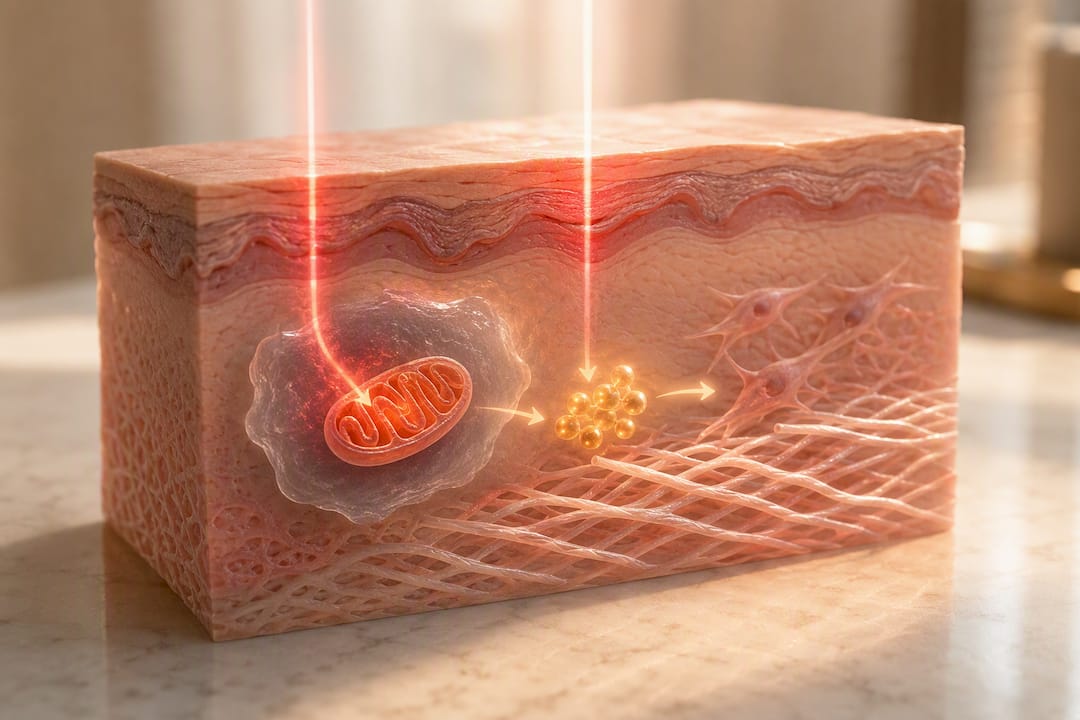
This increase in ATP has a cascading effect on fibroblasts, the cells responsible for producing collagen and elastin. Synthesis studies published on PMC associate repeated exposure to red light with increased collagen production and progressive remodeling of the extracellular matrix, the network of fibers that gives skin its firmness. It is this mechanism that explains its interest for fine lines and skin texture, much more than a superficial cosmetic effect.
However, light intensity, measured in irradiance (milliwatts per square centimeter), matters as much as the wavelength itself. A poorly calibrated device, even at the right wavelength, simply does not deliver enough energy to trigger these reactions. This is where the main gap lies between an effective device and a gadget that only produces red light without a measurable effect.
This dependence on dose, rather than light color, explains why two identical-looking LED masks can yield very different results.
What do studies say about its effectiveness against wrinkles, spots, and scars?
The most robust data concerns three areas: fine lines, skin texture, and inflammation related to acne. A review published on PMC reports measurable improvements after 4 to 12 weeks of regular use, with typical 10 to 12-minute sessions, repeated one to three times per week. This delay is significant: it corresponds to the time required for fibroblasts to produce new collagen in a visible way.

For inflammatory acne, red light alone provides a real anti-inflammatory effect, but the best-documented results often combine red and blue light, with the latter targeting the bacteria responsible for lesions. This is a nuance that many product descriptions gloss over by selling red light as a unique solution for acne.
Regarding pigment spots and diffuse redness, Harvard Health reports plausible benefits, while noting that optimal parameters remain poorly standardized from one study to another. Healing also benefits from a documented supportive effect, with red light accelerating certain tissue repair processes without replacing medical treatment for an already formed scar.
Caution is required regarding promises of a “facelift” or regained firmness in cases of advanced skin sagging. No serious data supports the claim that red light therapy regenerates dead hair follicles or reverses marked skin laxity. An analysis by Stanford Medicine also points out that effects vary greatly depending on the device, protocol, and area treated, and that generalizing study results for consumer use remains limited. In other words: the technique works for specific indications, not as a universal solution.
Who should avoid red light therapy, and what precautions should be taken?
The safety profile of red light is generally good in the short term. The Cleveland Clinic notes that it does not present the carcinogenic risks associated with UV rays, with the most common side effect being temporary redness that disappears in a few hours.
Some situations still require medical advice before any session. People with lupus or melasma must be particularly vigilant, as these conditions involve increased skin sensitivity to light. The same applies to anyone taking photosensitizing medication, whether it be certain antibiotics, oral retinoids, or dermatological treatments. In these cases, consulting before buying a device avoids unpleasant surprises.
Eye protection deserves special attention. Staring directly at an intense red light source, even without immediate pain, can cause eye strain or headaches, even in people without particular sensitivity. Shiny masks without built-in protection are the most problematic: it is better to close your eyes or wear the glasses provided with the device rather than skipping this detail.
Darker skin tones require a gradual approach. Starting with low irradiance and spacing out the first sessions allows you to check for any reaction before increasing the frequency, a precaution that limits the risk of hyperpigmentation. Dermatological follow-up remains useful in case of doubt, especially for skin already prone to spots.
What frequency and results can you realistically expect?
The best-documented protocols involve 10 to 12 minutes per session, repeated one to three times per week. The first visible changes—a more even complexion, smoother texture—generally appear between the fourth and twelfth week, rarely before.
Pro tip: do not judge a device after three sessions. Collagen production follows a slow biological rhythm; judge results at one month, then at three.
Irradiance matters more than exposure time. A powerful device used for ten minutes will deliver more energy than a weak device used for an hour, and extending a session beyond the manufacturer's recommendations does not accelerate results; it primarily exposes you to unnecessary irritation. This is the classic trap of “the longer, the better,” which simply does not apply here.
Professional devices used in offices generally deliver higher power and allow for individualized dose adjustment, which partly explains why their results are often faster than those obtained at home, according to Stanford Medicine's analysis. A well-chosen at-home device remains relevant, however, for regular maintenance.
In a routine, the session is ideally performed on cleansed skin, before applying topical treatments, to let the light act without the barrier of cream. Sun protection the next morning remains non-negotiable, as red light therapy in no way replaces daily sunscreen.
How to choose an at-home device over an in-office treatment?
Before comparing prices, check if the device has FDA clearance under the 510(k) procedure. This mention does not guarantee spectacular results, but it certifies that a technical file has been reviewed, unlike mere marketing claims.
Three technical data points are worth verifying before purchase: the exact wavelength, the targeted indication (face, scalp, body), and above all, the irradiance in milliwatts per square centimeter. Without this last piece of data, it is impossible to estimate the dose actually delivered, a point highlighted by the review published on PMC. A device that proudly displays its wavelength but remains vague about its irradiance warrants caution.
Regarding practical safety, choose a model that comes with protective goggles or a design that limits direct eye exposure, as well as clear after-sales support in case of malfunction. Our comparison between red light and blue light details the complementary uses of the two spectrums.
Office treatment remains preferable for complex conditions, marked scars, active dermatological pathologies, or simply for an initial diagnosis before investing in a personal device.
What the HBPS-Beauty editorial team concludes from clinical data
The clinical reviews consulted for this article, from PMC to Harvard Health and the Cleveland Clinic, converge on the same observation: red light therapy works, but within a specific framework and with realistic expectations. [author_bio]
This summary is based on the editorial experience accumulated on our aesthetic phototherapy guide, where we detail protocols and usage precautions based on field feedback.
Our practical recommendation, shared by the editorial team: always favor a device whose irradiance is clearly indicated, and consider the consistency of sessions as the most determining factor, even more so than the raw power of the device.
What most people misunderstand about red light
The most persistent misconception is that red light acts like a magic button that reverses skin aging in a few sessions. This is not what the data shows: the real benefits, for collagen and inflammation, are built slowly, over the scale of weeks, not days.
The opposite error also exists, which consists of dismissing the technique as a baseless marketing gadget. Cellular mechanisms are documented, clinical trials exist, but their scope remains modest compared to more invasive dermatological treatments. The real problem is not the effectiveness of red light itself, but the gap between what science measures and what some advertisements promise.
My conviction, after reviewing this work: the reader's priority should not be to look for the most powerful device, but the one with documented irradiance and a clear protocol. Modest but regular use over three months consistently beats a one-off session with an oversized device.
— JSCC
Finding a red light therapy device suited to your skin
A quality device, with a verifiable wavelength and clearly stated irradiance, makes all the difference between a routine that delivers results and an accessory that gathers dust after a month. A selection of at-home care devices designed for this regular use is available, accompanied by the necessary protective accessories for worry-free use.

Each device listed in the shop comes with clear product information, with no exaggerated clinical promises. For skin with specific conditions—melasma, photosensitizing treatments, dermatological history—prior medical advice remains the best guarantee before investing in a device. Our article on at-home anti-wrinkle routines usefully complements this reflection. To discover the range of available care devices, the Hbps-beauty shop remains the simplest starting point.
This article provides general information and does not replace the advice of a qualified physician. Consult a qualified health professional regarding your personal case before acting on the basis of this content.
Sources
- What to Look for in Red Light Therapy: A Product Guide … - PMC
- Red light therapy: What the science says - Stanford Medicine
- Red light therapy for skin care - Harvard Health
- Red Light Therapy: Benefits, Side Effects & Uses