

The role of daily sun care: protect your skin
TL;DR:
- The sun causes 80% of skin aging and 90% of skin cancers, even indoors or on cloudy days. Applying SPF 50 sunscreen daily, especially to often-neglected areas, significantly reduces long-term risks. Making this step part of your skincare routine helps prevent premature aging and skin diseases over time.
The sun is responsible for 90% of visible facial aging and more than 80% of skin cancers. Yet most of us apply sunscreen only at the beach, in summer, under clear skies. The role of daily sun care goes far beyond sunny vacations. Every car journey, every hour spent near a window, every cloudy day adds up to cumulative exposure that leaves its mark on the skin over the years, often with no immediate visible signs.
Table of contents
- Key takeaways
- Understanding the effects of UV rays on the skin
- Daily sun care: why it’s essential in the city
- How to choose and apply sun care products correctly
- The most common sun protection mistakes
- Adding sun care to your daily routine
- My take on adopting daily sun care
- Our sun care recommendations for your routine at Hbps-beauty
- FAQ
Key takeaways
| Key point | Details |
|---|---|
| UV rays are present year-round | UVA rays pass through clouds and windows, exposing the skin even on overcast days or indoors. |
| SPF 50 is recommended for daily use | For the face, SPF 50 offers the best safety margin under real-world conditions. |
| The amount matters as much as the SPF | Applying too little sunscreen reduces the actual protection to around 25% of the labeled amount. |
| Common mistakes to correct | The ears, lips, and eyelids are often forgotten, even though they are highly exposed. |
| A hybrid routine makes protection easier | A day cream with built-in SPF protects the skin without adding an extra step. |
Understanding the effects of UV rays on the skin
Ultraviolet rays fall into two categories, each with very different effects on your skin. UVB rays cause sunburn and play a direct role in the development of skin cancers. Their intensity varies with the season, time of day, and altitude. UVA rays penetrate much deeper into the dermis. They break down collagen, promote pigmentation spots, and accelerate cellular aging. Their levels remain nearly constant throughout the year, including in winter.
What few people realize is that UVA rays pass through windows without being weakened at all. Driving every day, working near an office window, or simply looking out at the street from home: each of these moments adds a silent dose of UV exposure. The cumulative effect of UV rays causes damage to skin cell DNA and chronic inflammation, often without any visible warning signs for years.
The figures are clear: the number of melanomas more than tripled in France between 1990 and 2023, with 18,000 new cases diagnosed in 2023 alone.
The effects of UV rays on the skin fall into three broad categories:
- Premature aging: wrinkles, loss of firmness, and brown spots caused by chronic UVA exposure.
- Sunburn and acute reactions: caused by UVB rays during intense, unprotected exposure.
- Cancer risk: accumulated cell mutations that can lead to carcinomas or melanomas over the years.
Understanding these mechanisms means understanding why waiting until summer or sunny weather to protect yourself isn’t enough. The skin accumulates every dose and never resets the counter.
Daily sun care: why it’s essential in the city
Many people think a cloudy day in Paris isn’t a risky day. That’s wrong. Clouds filter out no more than 20% of UVA rays. The rest reaches your skin just as it would in sunny weather, without you feeling it. This is precisely why daily sun care is so important.
Daily sunscreen use reduces the risk of squamous cell carcinoma, one of the most common skin cancers, by 39%. Yet only 35% of people protect themselves from the sun every time they go outdoors. These figures reveal a real gap between awareness of the risks and the habits people adopt.

So-called “invisible” daily exposure is especially deceptive. A ten-minute commute in the morning, a lunch break outdoors, a glance out the window: each tiny exposure adds up. Over a lifetime, these accumulated exposures amount to a volume of UV comparable to several weeks of unprotected vacation in the sun.
Pro tip: Keep your sunscreen right next to your toothbrush. This simple trick helps make it a habit: you won’t leave home without applying it, just as you wouldn’t leave without brushing your teeth.
Effective sun protection is one of the best-documented preventive measures in dermatology. The science is unequivocal. What’s missing is the daily habit, not the information.
How to choose and apply sun care products correctly
Choosing the right SPF
SPF 30 blocks around 97% of UVB rays, while SPF 50 blocks around 98%. The difference seems small, but under real-world conditions (not applying enough or forgetting to reapply), SPF 50 offers a much greater safety margin. SPF 50 has become the recommended standard for the face in urban settings, even outside summer. For the body in full sun, SPF 30 is still acceptable as long as it is reapplied regularly.
Mineral or chemical filters?
| Criteria | Mineral filters | Chemical filters |
|---|---|---|
| How they work | Reflect UV rays at the skin’s surface | Absorb and transform UV rays |
| Skin tolerance | Excellent; ideal for sensitive skin | Varies depending on the ingredients |
| Texture | Often thicker, may leave a white cast | Lighter, invisible on the skin |
| Protection spectrum | Broad-spectrum UVA + UVB | Depends on the formulation |
Mineral sunscreens containing zinc oxide or titanium dioxide are particularly suitable for reactive or acne-prone skin. Chemical formulas are often more comfortable under makeup thanks to their lightweight texture. Neither type is universally better: it all depends on your skin type.
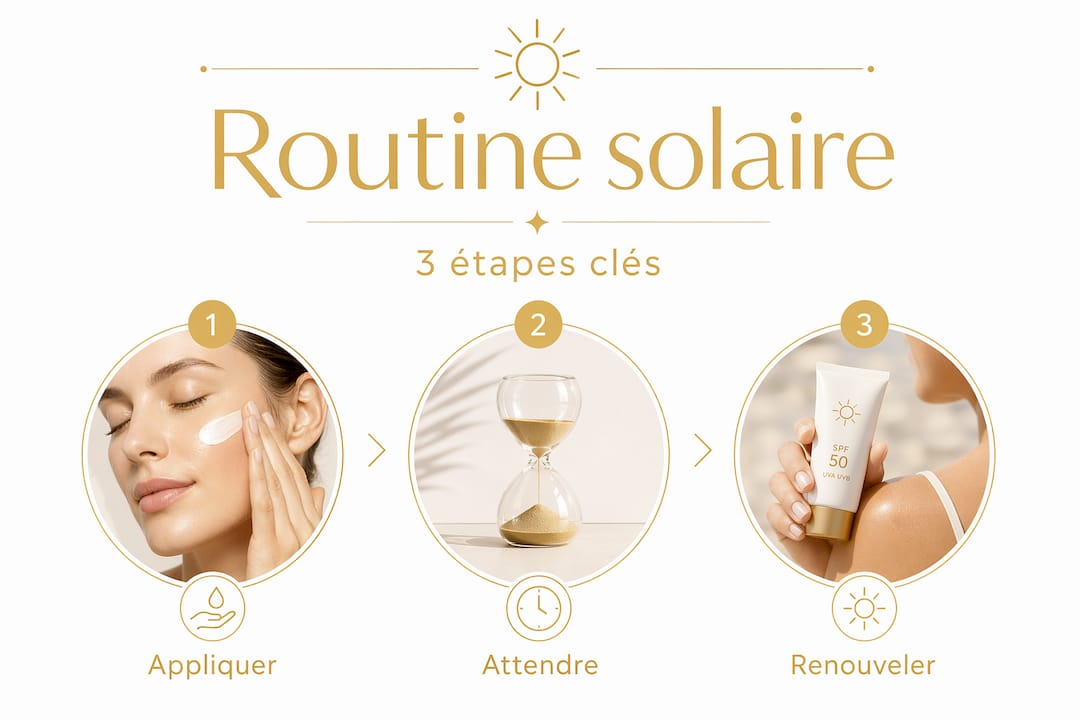
Applying correctly: the step-by-step rule
The “measure, dot, spread” technique ensures even coverage. For the face, you need half a teaspoon. Most users apply only 25 to 50% of that amount, reducing the actual protection to around 25%. Commonly neglected areas include:
- The ears and the area around them
- The eyelids and eye area
- The lips (an SPF lip balm is enough)
- The neck and décolletage
- The backs of the hands
Pro tip: Apply your sunscreen 15 to 20 minutes before going out in the sun to give chemical filters time to form their protective film. Mineral filters provide immediate protection upon application.
Reapplying every two hours is essential when outdoors, and after swimming or heavy sweating, even with a formula labeled “water resistant.”
The most common sun protection mistakes
Good intentions aren’t enough if you apply sunscreen incorrectly. Here are the mistakes most people make, even those who think they’re protecting themselves properly:
- Not applying enough: using too little sunscreen is probably the most common mistake. Spreading a pea-sized amount over your whole face won’t give you the SPF stated on the packaging.
- Thinking SPF alone is enough: sun protection works best as part of an overall strategy that includes covering clothing, a hat, and seeking shade between 11 a.m. and 4 p.m.
- Not reapplying: 80% of regular users don’t reapply their sunscreen on cloudy days because they think they don’t need to.
- Forgetting sensitive areas: the ears, eyelids, and lips are among the areas most affected by skin cancers—and among those most often overlooked when applying sunscreen.
- Rubbing too vigorously: spreading sunscreen too vigorously disrupts its protective film. Apply it gently using light patting and gradual smoothing motions.
Correcting these mistakes doesn’t require any extra products. It simply means adjusting your routine with gestures that take an extra thirty seconds.
Adding sun care to your daily routine
The real question isn’t “should you protect yourself?” but “how can you make this step as automatic as washing your face?” The answer is to keep things simple. Adding sun protection to a hybrid day cream lets you moisturize and protect in a single step, without lengthening your morning routine.
To choose the right product for your lifestyle, ask yourself these questions:
- Your skin type: oily or combination skin? Choose fluid or gel textures. Dry skin? Look for rich formulas that combine SPF with nourishing ingredients.
- Your usual sun exposure: indoors all day for work? SPF 50 in the morning is enough. Spend time outdoors? Plan to reapply at midday.
- Whether you wear makeup: SPF compact powders or protective mists let you reapply without disturbing your foundation.
The long-term benefits go far beyond cancer prevention. A clinical study showed that daily application of SPF 50 improves skin firmness and reduces pigmentation spots after just 56 days of regular use. Your skin ten years from now will thank you for the choices you make today.
Pro tip: To make it easy to add sun protection to your routine, choose a product you genuinely enjoy using: a pleasant texture, neutral scent, and finish that suits your skin. A product you like applying is one you’ll actually use every day.
To learn more about how to build your beauty routine and incorporate sun protection into it for the long term, comprehensive guides are available to help you find the right approach for your needs.
My take on adopting daily sun care
Over the years, I’ve noticed a striking difference between people who adopted daily sun protection early and those who waited until the first visible signs of aging appeared. The former have more even, firmer skin with fewer spots than their peers. It’s not a matter of genetics. It’s a matter of consistency.
What convinces me most is precisely the lack of warning signs. You don’t burn, you don’t turn red, you don’t feel a thing. But UV rays are silently doing their work, day after day. Sun protection isn’t just for days with intense sunshine. It’s for every day, without exception.
I’d also say this: many people give up the habit because they feel it “doesn’t make a difference” when the sun is obscured by clouds. The opposite is true. Cloudy days are when a false sense of security is most dangerous. A good sunscreen suited to your skin, applied correctly every morning, is one of the most worthwhile investments you can make in your skin health.
— JSCC
Our sun care recommendations for your routine at Hbps-beauty
At Hbps-beauty, we’ve selected products designed to fit naturally into your everyday routine, without compromising on effectiveness.

Beauté Mediterranea’s Antiox SPF50 Facial Sunscreen combines active hydration with broad-spectrum UVA/UVB protection in a lightweight formula, ideal for everyday use in the city. For anyone looking for an all-in-one approach that combines protection, nourishment, and long-term skin support, Pharmanex Beauty Focus MultiBeauty offers a comprehensive approach to preventive care. Both products are available directly from Hbps-beauty, along with advice on how to choose the right facial skincare for your skin type.
FAQ
Is daily sun care really useful on cloudy days?
Yes. Clouds filter out only some of the UVA rays, which are present all year round. Daily application is still essential, even when there’s no visible sunshine.
What SPF should I choose for daily use in the city?
SPF 50 is currently recommended for daily use on the face in urban settings. It offers a better safety margin under real-world application conditions, when people often apply too little.
How many times a day should you reapply sunscreen?
Outdoors, reapplication every two hours is necessary, as well as after every swim or heavy sweating. Indoors with limited sun exposure, applying it once in the morning may be enough.
Are mineral sunscreens better than chemical sunscreens?
Neither is universally superior. Mineral filters are better suited to sensitive skin, while chemical filters offer lighter textures under makeup. The best one is the one you’ll actually use every day.
Can you use a day cream with SPF instead of sunscreen?
Yes, provided the SPF is at least 30, preferably 50, and you apply a sufficient amount. A hybrid moisturising and protective product simplifies your routine without compromising effectiveness.