

Which size round brush should you choose for your hair?
For most at-home styling, a small round brush is suitable for short cuts and bangs, a medium brush for mid-lengths, and a large brush for smoothing or shaping long hair. The rule that settles all doubts: the hair section must be able to wrap at least one full turn around the barrel. For more curve, go down a size; for more smoothing, go up a size.
In brief:
- The ideal brush size depends on hair length, ranging from small for very short hair to large for long or thick hair.
- The size of the barrel should allow the hair section to wrap around completely, adjusting if necessary to prevent it from getting stuck.
- For fine hair, choose a small brush to avoid flattening volume, whereas thick hair requires a large brush for efficient drying.
- For bangs, use a brush one to two sizes smaller than the one used for the rest of the hair, working in small sections for a precise result.
- A kit of four diameters (25, 32, 43, 53 mm) covers most domestic needs, always checking the precision of the diameter in millimeters.
Table of contents
- Overview of round brush sizes: from millimeters to inches
- Which round brush size based on hair length?
- Your hair texture matters as much as its length
- Which round brush size for successful bangs?
- How to assemble a round brush kit without mistakes
- Why Hbps-beauty recommends these size benchmarks
- What you really need to remember before plugging in the hairdryer
- A brush kit designed to cover all your lengths
- Sources
Overview of round brush sizes: from millimeters to inches
Manufacturers do not all use the same numbering scale. A "size 8" brush from one brand may measure several millimeters more than the same reference from another, which makes internal numbers unreliable for comparing two different products. The only benchmark that truly counts is the diameter in millimeters written on the packaging or in the product specifications.
Three families cover most needs:
- Small brushes: maximum control, small curls, bangs, and very short hair.
- Medium brushes: balance between volume and smoothing, suitable for mid-length hair.
- Large brushes: smoothing effect, soft curve at the ends, ideal for long or thick hair.
This comparison chart remains the reference most cited by hairdressers for matching hair length to a specific diameter. Simply remember this: the thinner the barrel, the tighter the curl; the larger it is, the more the result leans toward a smooth blowout.
Which round brush size based on hair length?
The diameter that works for a short bob has no chance of holding on mid-length hair, and conversely, a large brush will slide without gripping on a pixie cut. Here are the benchmarks most often used by professionals:
- Pixie and very short hair: small brush, to structure the roots and add volume without creating a curl.
- Lob and short bob: intermediate size, a compromise between hold and movement.
- Mid-length: medium brush, the most versatile range for a shiny blowout with a slight shape at the ends.
- Long and thick: large brush, for smoothing without breaking the length and achieving a silky finish.
A simple trick avoids much frustration: if the hair section wraps around several times and gets stuck in the barrel, it means the section is too large or the brush is too small for this length. Reduce the section size before changing the brush; this often solves the problem faster. For long hair, always work in zones rather than the whole head at once: drying is faster and the result is more consistent.
Your hair texture matters as much as its length
Length provides a foundation, but texture adjusts the final choice. With fine hair, a brush that is too large flattens volume and requires heat for longer than necessary, leading to disappointing results.
- Fine hair: favor small sizes, moderate heat, and a systematic heat protectant spray, as this hair does not tolerate repeated passes well.
- Thick hair: opt for a large barrel, work in generous sections, and let each zone dry completely before moving to the next.
- Curly or frizzy hair: a small brush redefines and tightens the curl, while a large brush relaxes it for a looser effect.
- Barrel material: ceramic and ionic coatings distribute heat more evenly and limit hot spots, unlike bare metal barrels which snag more and heat unevenly.
Pro tip: On colored or damaged hair, reduce the temperature of your hairdryer by one notch even before thinking about changing brush size. The diameter corrects the shape, not the thermal damage.
Which round brush size for successful bangs?
The most useful rule for bangs is also the simplest: take a brush one to two sizes smaller than the one used on the rest of the hair. Bangs are styled on a thin section of hair, so a barrel that is too large simply prevents the hair from wrapping correctly.
- Baby bangs and very short bangs: small brush, for total control over a small section.
- Classic blunt bangs: medium-sized brush, the balance between hold and flexibility.
- Curtain bangs: medium to slightly large size depending on the length, for a more open movement on the sides.
Work in small sections, apply gentle tension without pulling harshly, and finish each section with a blast of cool air to set the shape before releasing the bang brush. The sizes most repurchased in salons for this type of styling remain medium sizes around 32 mm to 43 mm, which cover most client requests for bangs and mid-length blowouts.
How to assemble a round brush kit without mistakes
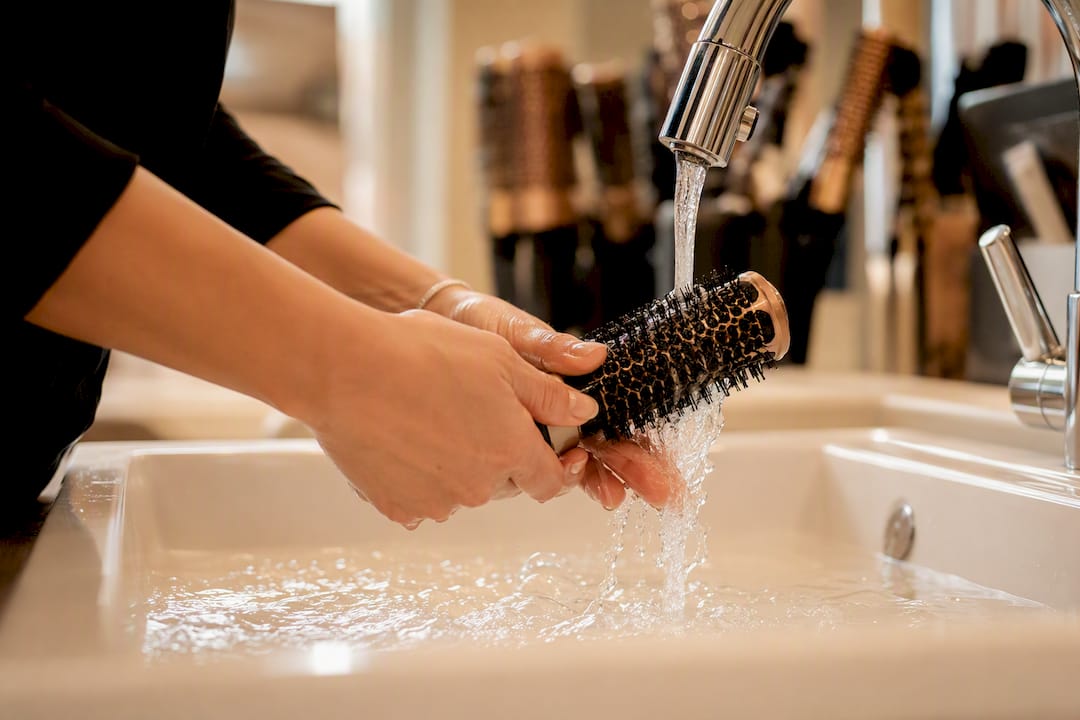
Before buying, ask yourself three simple questions: what is your hair length today, what type of styling do you look for most often, and how frequently will you really use this brush? These answers prevent accumulating unnecessary sizes.
Then check these points on the product sheet:
- The exact diameter in millimeters, never just the manufacturer's number.
- The barrel material: ceramic or ionic for shine, natural bristles for tension, synthetic bristles for detangling.
- The shape of the handle, which should remain comfortable even after fifteen minutes of blow-drying.
A kit covering most domestic needs generally combines four diameters: 25 mm, 32 mm, 43 mm, and 53 mm. This combination allows you to go from bangs to a long blowout without ever forcing a section that is too large for the barrel.
Pro tip: Replace your brush as soon as the bristles lie down irregularly or the barrel loses its coating: a damaged surface snags hair and damages the cuticle far more than the wrong diameter.
For routine maintenance, a guide dedicated to hair accessories details bristle cleaning and replacement frequency.
Why Hbps-beauty recommends these size benchmarks
These recommendations are based on diameter charts used by professional manufacturers and usage feedback gathered in our hair accessory comparison, which highlights the reduction in breakage linked to choosing an appropriate diameter.
- A practical hair routine guide complements this article with detailed styling steps.
- The mm/inch benchmarks cited here come from manufacturer charts widely recognized in the sector.
What you really need to remember before plugging in the hairdryer
The right brush size never replaces proper thermal protection. Much breakage comes less from the chosen diameter than from repeated passes at too high a temperature on the same section. Test first on an inconspicuous area, let it cool before judging the result, and always keep a heat protectant spray on hand.
— JSCC
A brush kit designed to cover all your lengths
Assembling a kit yourself with four different diameters takes time and several attempts before finding the right balance. The Diva Pro Styling volume brush offered by Hbps-beauty was designed precisely to cover several uses without multiplying purchases, with a barrel whose coating limits the hot spots mentioned above.

On the shop, each reference lists its exact diameter in millimeters, not just a range number, which avoids matching errors between brands. Customer service assists with returns and exchanges if the chosen size ultimately does not suit your hair length. Visit the Hbps-beauty homepage to compare available diameters and assemble the kit that matches your current cut.
Sources
The diameter charts in millimeters come from the Mackay and Olivia Garden size guides, two references for choosing a barrel adapted to every bang.
- Round Hair Brush Size Chart (0.75–2.5"): Choose the Right Size for Your Hair
- Paint brush size chart / Round brush size ladders (explain variability)