

Scalp massager: 4 minutes a day, what do the studies say?
A scalp massage provides almost immediate relaxation and, with regular practice, can contribute to a healthier scalp and visibly thicker hair. However, scientific evidence remains limited and does not support promises of regrowth in areas where follicles have already atrophied.
In short:
- If you practice scalp massage regularly, expect an improvement in the thickness of existing hair after about six months of daily application.
- Mechanical stimulation promotes local blood circulation, increasing the supply of oxygen and nutrients to the follicles, but cannot regrow hair in areas where follicles are atrophied.
- Studies show a measurable increase in hair thickness in men following daily massage, although the results remain modest and are primarily related to the health of existing follicles.
- It is recommended to apply a serum or hair oil immediately after the massage to optimize absorption through the still-open pores.
- Massage should be avoided in cases of an infected or irritated scalp or severe hair loss without viable follicles, and should always be accompanied by a medical diagnosis if necessary.
Table of Contents
- The benefits of a scalp massager, in detail
- What do scientific studies really say?
- How to massage your scalp effectively
- How often and for how long?
- Fingers, silicone brush, or electric massager: which to choose?
- When to avoid scalp massage
- How to integrate massage into a consistent hair care routine
- Where to find a scalp massager suited to your routine
- Sources
The benefits of a scalp massager, in detail
A scalp massager acts on several levels at once, and it is this exact combination that explains its growing popularity among both individuals and beauty professionals.
Mechanical stimulation of the scalp promotes local blood circulation, which brings more oxygen and nutrients to the hair follicles. A controlled study measured this phenomenon quite concretely: in men who practiced a standardized massage for several minutes a day over several weeks, the average hair thickness increased measurably. The difference may appear modest on paper, but it reflects a real change in the hair fiber over nearly six months of daily practice.
Here are the five most documented effects:
- Increased blood circulation, which better nourishes the hair follicle.
- Progressive thickening of existing hair, observed over several months.
- Deep relaxation, with a measurable decrease in stress hormones.
- Gentle exfoliation of the scalp, which removes dead cells and excess sebum.
- Better absorption of serums and topical treatments applied right after the massage.
Pro tip: apply your serum or hair oil immediately after the massage, when the scalp pores are still open from the mechanical stimulation. Absorption is significantly improved.
The relaxing effect is not just a side benefit. Regular cranial massage sessions can lower stress biomarkers such as cortisol and norepinephrine, with a measurable effect on blood pressure in certain protocols. For many, it is this benefit—more than hair thickness—that justifies including the practice in their evening routine.
What do scientific studies really say?
The most cited reference remains the Japanese study on scalp massage, which tracked male volunteers for twenty-four weeks using a standardized protocol. It documented a measurable gain in hair thickness, and, more importantly, opened an interesting mechanistic avenue: mechanotransduction.
This term refers to how a physical force, in this case, the pressure of the massage, translates into a biological signal. Researchers observed that stretching the dermal papillae modified the expression of genes linked to the hair cycle, notably NOGGIN, BMP4, SMAD4, and IL6. Some work goes further, suggesting that this mechanical pressure could activate pathways like Wnt or influence potassium channels sensitive to mechanical stress—mechanisms that, on paper, bring the effect of massage close to that of pharmacological treatments like minoxidil.
However, one must maintain a critical eye on these data:
- The samples studied remain small, often involving only a few dozen participants.
- A self-reported survey conducted in 2019 indicates that nearly 69% of participants practicing regular massages perceived an improvement in their alopecia—a figure to be taken with caution since it is based on subjective feeling and not clinical measurement.
- No serious study demonstrates regrowth in an area where follicles are already atrophied.
A synthesis on the subject reminds us that scalp massage can support circulation, exfoliation, and relaxation, but that solid clinical evidence remains rare and primarily concerns the thickness of existing hair, not the creation of new active follicles.
If you notice significant hair loss or bald patches, a massage is never a substitute for a medical diagnosis. It can accompany one, but never replace it.
How to massage your scalp effectively
Technique matters as much as consistency. Here is a simple sequence to reproduce at home:
- Get comfortable, with dry or slightly damp hair, and relax your jaw and shoulders before starting.
- Place your fingers in a fan shape on the scalp, moving from the forehead toward the nape of the neck, without pressing hard.
- Perform circular motions with moderate pressure, focusing on the temples and the crown of the head.
- Gradually move toward the back of the head, covering the entire surface, for three to five minutes.
- Finish with static pressure for a few seconds on the areas with the most tension, often at the nape of the neck.
Certain variations are worth trying: the "pinch-and-roll," which delicately pinches the skin between the fingers, the scalp gua sha adapted from facial care, or even the silicone brush used directly in the shower with shampoo, which combines massage and cleansing in one step.
The best time remains just before shampooing, when the scalp is still dry and the pressure helps lift away impurities.
To deepen your overall hair care routine, our article on the benefits of hair care details other complementary practices.
How often and for how long?
- For relaxation only: a few minutes each evening are enough, with no specific time constraints.
- To target an effect on hair thickness, the reference study used four minutes per day for twenty-four weeks, meaning nearly six months of daily practice before observing a measurable change.
- Other protocols rely on longer sessions, from fifteen to twenty minutes, but spread over only two to three times a week.
- Expect generally between eight and twenty-four weeks before judging an effect on density or thickness; relaxation, however, is felt from the very first session.
Consistency is more important than intensity. An occasional massage at a salon, once a month, does not reproduce the effects of a daily practice at home.
Fingers, silicone brush, or electric massager: which to choose?
Each tool has its strengths, and the best choice depends primarily on your goal and your sensitivity to the sensation.
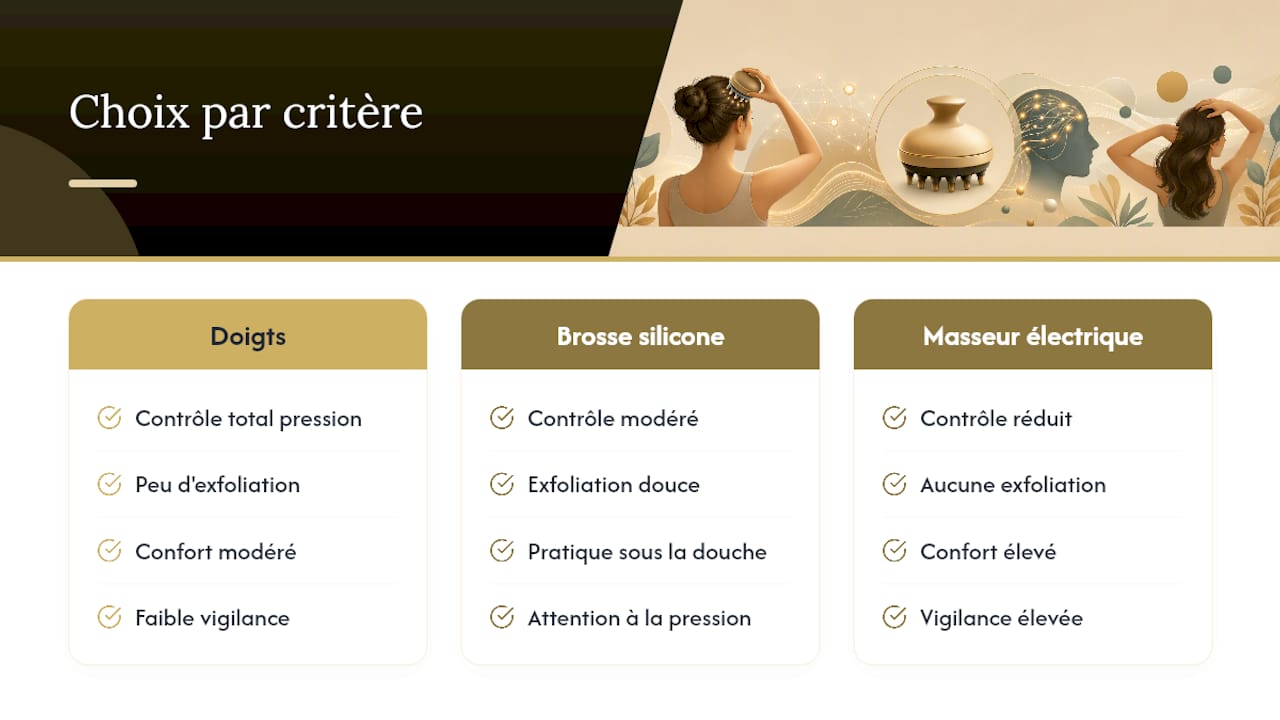
Fingers remain the safest and most accessible option: you have full control over the pressure, without the risk of pulling on the hair, and it costs nothing. It is the ideal starting point for learning the technique.
The silicone brush adds an exfoliation dimension to the stimulation, which is particularly practical in the shower during shampooing. Its flexible bristles clean deeply without irritating the scalp, provided you don't press too hard.
Electric massagers offer definite comfort for long sessions, but their automatic intensity requires caution: it is better to start at low power and avoid any movement that pulls on the roots rather than massaging them.
Regarding complementary products, certain essential oils like rosemary, lavender, or peppermint are sometimes used in combination with massage. The data primarily come from animal trials or small exploratory human trials, so a preliminary skin patch test remains essential before any application.
When to avoid scalp massage
Massage is not innocuous in all situations. A few precautions are necessary:
- Avoid any massage on an infected, irritated, or wounded scalp; the motion could worsen inflammation or spread an infection.
- Ban any pulling motions or those that are too forceful, which weaken the hair fiber and can break the hair rather than strengthen it.
- Do not rely on massage alone to regrow hair on a completely bald area: without viable follicles, no mechanical stimulation is enough.
- Consult a dermatologist in case of significant, sudden hair loss, or if it is accompanied by itching, redness, or persistent scales.
How to integrate massage into a consistent hair care routine
Scalp massage keeps its promises on two solid fronts: immediate relaxation and a measurable effect on the thickness of existing hair, provided you are consistent over several months. Regarding actual regrowth, caution is advised.
The real lever is consistency: combine massage with good hair hygiene, a proper diet, and medical advice if hair loss persists. Our article on why you should take care of your scalp explores this logic of a comprehensive routine rather than an isolated practice.
— JSCC
Where to find a scalp massager suited to your routine
You can choose from silicone brushes, electric massagers, and hair serums from recognized brands, without having to compare dozens of scattered shops.

The difference lies in the selection: each category, from hair accessories to home care devices, is designed to be integrated into a complete hair care routine rather than sold as an isolated gadget. To complement your daily practice, our selection of tips for visibly healthier hair pairs well with choosing the right accessory. Visit the Hbps-beauty catalog now to compare available options and start your routine.
Sources
- Scalp massage study (PMCID PMC4740347)
- Scalp Massage for Hair Growth: Does It Really Work? (Healthline)
This article provides general information and does not replace the advice of a qualified physician. Consult a qualified healthcare professional regarding your personal case before acting on the basis of this content.