

Sensitive skin care: an effective, irritation-free routine
TL;DR:
- Sensitive skin has a weakened skin barrier, requiring specific care to strengthen it.
- You should prioritize hypoallergenic products, free from fragrance and alcohol, containing ceramides, hyaluronic acid, and niacinamide to restore the barrier.
Have you ever bought a cream proudly labeled "for sensitive skin," only to discover your skin turned red after the very first application? You are not alone. Many supposedly suitable products can contain hidden irritants like synthetic fragrances, harsh preservatives, or denatured alcohols. This confusion between "gentle" and "truly suitable" leads thousands of people to make repeated purchases without results. In this article, we will clarify what true sensitive skin care is, give you concrete criteria for choosing well, build a simple and safe routine, and teach you how to adapt it according to the seasons.
Table of Contents
- Definition of skincare suitable for sensitive skin
- Essential criteria for sensitive skin care
- A minimalist and safe routine for sensitive skin
- Adapting your routine to seasons and special cases
- Why simplicity is key, despite trends
- Discover our beauty solutions suitable for sensitive skin
- Frequently asked questions
Key Points
| Point | Details |
|---|---|
| Prioritize simplicity | Fewer ingredients reduce the risk of irritation on sensitive skin. |
| Test first | Try any new skincare with a 48-hour patch test before widespread use. |
| Adapt to the season | Change your routine when the weather or environment shifts. |
| Consult if in doubt | Seek a dermatologist for any persistent or severe symptoms. |
Definition of skincare suitable for sensitive skin
Having set the context, let us clarify what skincare truly suitable for your skin type actually is.
Sensitive skin is not diseased skin. It is skin whose barrier—the natural protective film that retains water and wards off external aggression—is weakened. It reacts more easily to changes in temperature, cosmetic products, stress, or pollution. Redness, tightness, and mild tingling are its usual warning signals.
Irritated skin, on the other hand, is a temporary reaction. Your normal skin may become irritated after an overly harsh scrub or exposure to cold. Conversely, sensitive skin is a chronic, often constitutional condition. This distinction is fundamental when you are looking to choose a customized routine: the solutions are not the same.
The skin barrier of sensitive skin functions like a cracked wall. Even slight pressure can cause seepage. The goal of your skincare is not to mask the symptoms, but to repair and strengthen this wall.
To understand which types of facial care meet your needs, you must first understand what your skin is lacking and what is attacking it. The ingredients to prioritize are well-documented and validated by dermatologists. According to specialized recommendations, hypoallergenic fragrance-free formulas containing ceramides, hyaluronic acid, niacinamide, panthenol, aloe vera, oats, or calendula are the most effective for restoring the skin barrier, soothing inflammation, and deeply hydrating.
Here are the ingredients to look for on your labels first:
- Ceramides: reconstitute the skin's lipid barrier
- Hyaluronic acid: hydrates without causing occlusion or comedones
- Niacinamide: reduces redness and strengthens skin tolerance
- Panthenol (vitamin B5): soothes and accelerates minor healing
- Aloe vera: natural cooling and anti-inflammatory effect
- Colloidal oatmeal: protects the skin and reduces itching
- Calendula: soothing extract known for very reactive skin
To compare beauty brands and identify those that include these active ingredients without drowning them in overloaded formulas, learning to read the INCI (the official ingredient list) is a real advantage.
Essential criteria for sensitive skin care
Now that the definition is clear, let's see how to recognize the best skincare through their objective criteria.

A good skincare product for sensitive skin is more than just the absence of a problematic ingredient. The entire formula must be designed to minimize the risk of reaction. Here is a comparison table of criteria to check before any purchase.
| Criterion | Look for | Avoid |
|---|---|---|
| Fragrance | Fragrance-free | Parfum, Fragrance, Linalool |
| Preservatives | Phenoxyethanol (max 1%), tocopherol | Parabens, MIT, formaldehyde |
| Alcohol | Fatty alcohols (cetearyl alcohol) | Denatured alcohol, ethanol at the top of the list |
| Texture | Aqueous gel, light emulsion, neutral balm | Very thick formulas with heavy silicones |
| Ingredient count | Short list (ideally fewer than 15 ingredients) | Formulas with 30+ lesser-known ingredients |
| Tests | Dermatologically tested, hypoallergenic | Vague claims like "natural" or "organic" without certification |
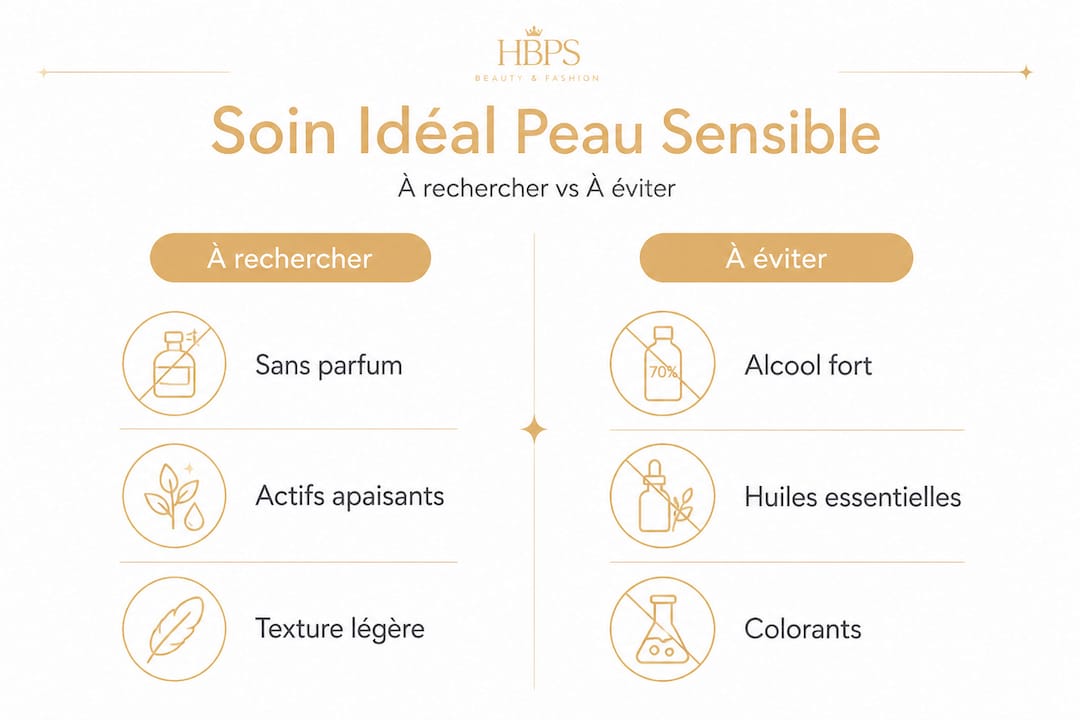
Marketing claims like "natural" or "plant-based" guarantee nothing. Eucalyptus essential oil or lemon are natural and yet very irritating to sensitive skin. Vigilance is essential.
Before introducing a new product into your routine, follow these steps in order:
- Read the full INCI list and verify the absence of the problematic ingredients listed above
- Check if the product explicitly mentions dermatological testing on sensitive skin
- Perform a patch test on the inside of the wrist for 48 hours
- If no reaction appears, apply it to a small area of the face for 3 days
- Add it permanently to your routine only after full validation
Pro tip: never introduce two new products at the same time. If a reaction occurs, you won't know which one is responsible, which makes identifying the culprit extremely complicated.
Pediatric cases deserve special attention. Pediatrically tested products are recommended for babies and young children, while for adults, a dermatological consultation remains the best way to rule out conditions like rosacea or eczema, which require specific care far beyond standard cosmetics.
If you are considering using a home skincare device as a supplement to your topical treatments, choosing a beauty device suitable for sensitive skin requires the same precautions: verify compatibility with your skin type before any use.
A minimalist and safe routine for sensitive skin
We have seen the criteria; let's move on to the methodology for building a truly suitable and protective routine.
The temptation to multiply products is real, especially when social media presents 10-step routines as the norm. For sensitive skin, this is often counterproductive. Fewer products mean fewer risks of cross-reactions. A minimalist routine that strengthens the skin barrier yields visible results in 4 to 6 weeks, provided it is applied consistently.
Here is a simple 3 to 4-step routine framework, for morning and evening:
- Gentle cleansing: soap-free gel or alcohol-free micellar water, rinsed with lukewarm—never hot—water
- Active moisturizing care: cream or serum based on ceramides and hyaluronic acid according to your needs
- Sun protection (morning only): SPF 30 minimum, mineral formula with zinc oxide for highly reactive skin
- Repairing care (evening, if needed): nourishing balm with panthenol or calendula, applied to slightly damp skin
Here is a sample weekly routine table for sensitive skin:
| Day | Morning | Evening | Special action |
|---|---|---|---|
| Monday to Friday | Cleanse + moisturize + SPF | Cleanse + repair | None |
| Saturday | Cleanse + moisturize + SPF | Soothing mask (white clay or oats) | Patch test if new product |
| Sunday | Gentle cleanse only | Thick nourishing treatment | Observation and weekly review |
Pro tip: if your skin is extremely intolerant, incorporate effective beauty routines enriched with postbiotics or probiotics. These active ingredients rebalance the skin microbiome—the population of good bacteria living on your skin—and gradually reduce hypersensitivity. Certain thermal cures, particularly at Avène or La Roche-Posay, also offer supervised protocols for the most reactive skin types with clinically proven results.
The most common mistake remains the premature abandonment of a routine after 1 or 2 weeks without spectacular results. The skin needs time to recalibrate. Stay consistent, avoid abrupt changes, and observe your skin's signals week after week.
Adapting your routine to seasons and special cases
You know the basics; it remains to understand when and how to evolve your routine according to the circumstances.
A routine that works in summer may be insufficient in winter and vice versa. Seasonal variations worsen reactions in sensitive skin, whether due to cold drying out the skin barrier or spring renewal accompanied by a rise in pollen. Intolerant skin, the most reactive of all, requires ultra-minimalist formulas reduced to the essentials.
Here is how to concretely adapt your routine for each season:
- Winter: boost hydration with richer textures containing ceramides. The dry air from indoor heating worsens tightness. Limit hot showers and prefer lukewarm water.
- Spring: pollen season and therefore flare-ups for sensitive-allergic skin. Lighten formulas, avoid botanical actives potentially cross-reactive with respiratory allergens.
- Summer: the sun is a major trigger. Double up on mineral sun protection and refresh your skin with thermal water sprays.
- Autumn: a transition period. Gradually reintroduce repairing actives to prepare the skin for winter aggressions.
Always consult a dermatologist if your reactions persist for more than 2 weeks despite adapting your routine. Certain sensitivities mask conditions like rosacea, atopic dermatitis, or contact allergies that require medical treatment.
To choose facial care suitable for each time of year, the golden rule is this: observe your skin every morning, note its reactions over a week, and adjust accordingly. This simple tracking will give you more information than any ingredient list.
Current healthy skin dermocosmetics offer solutions designed at the intersection of medical care and cosmetics, often clinically tested on highly reactive skin. These lines, available in pharmacies or at specialized retailers, offer a level of formal safety that mass-market products do not always guarantee.
Why simplicity is key, despite trends
After this practical overview, let's take a step back and consider the reflexes to develop when faced with the profusion of cosmetic offerings.
On TikTok or Instagram, you have certainly seen routines with 8, 10, sometimes 15 products presented as the ultimate solution. Star ingredients are launched every season: bakuchiol replaces retinol, centella asiatica succeeds CBD, and so on. For sensitive skin, following these trends is often a direct source of problems.
Each new product introduced into your routine is an additional variable. The more you accumulate, the more you increase the risks of interactions between active ingredients, overloading the skin barrier, and confusion in the event of a reaction. Overconsumption of cosmetic products is not a care strategy. It is a marketing strategy brilliantly disguised as beauty expertise.
Our conviction, based on what dermatology has recommended for decades, is that prevention is always better than repair. Well-hydrated skin, with a barrier strengthened by a few targeted actives, will naturally resist aggression. You won't need to "treat" a reaction you haven't triggered.
The role of antioxidants in routines for sensitive skin is often neglected in favor of trends. Yet, simple ingredients like vitamin E or green tea help neutralize free radicals without irritating reactive skin. They are discreet but terribly effective allies in the long run.
True beauty expertise for sensitive skin does not look like a shelf full of products. It looks like a short, consistent routine, chosen with care and applied with regularity. Ignore miracle promises. Trust the data, the clinical tests, and your own daily observations.
Discover our beauty solutions suitable for sensitive skin
To start your routine off right, HBPS-Beauty selects demanding formulas that protect your skin every day.
At HBPS-Beauty, we have done the selection work for you. Every product listed on our platform is chosen according to strict quality criteria, with particular care for ranges suitable for reactive and sensitive skin.

For skin seeking nutritional support in addition to topical care, the Beauty Focus MultiBeauty Pharmanex by Nu Skin offers a complete approach from within, with targeted nutrients to support skin health in depth. Combining suitable topical care with targeted nutrition means addressing skin sensitivity from all angles. Explore our selection and do not hesitate to contact us for personalized advice based on your skin type and specific needs.
Frequently Asked Questions
How do I know if I really have sensitive skin or an allergy?
Sensitive skin reacts quickly to external aggressors but without severe itching or significant patches. If in doubt, consult a dermatologist to rule out rosacea or eczema.
What should I do in case of a reaction to a new skincare product?
Stop using the product immediately, apply a cold thermal water compress, and consult a professional if the signs persist. For severe cases, thermal cures at Avène offer supervised soothing protocols.
Should I avoid all fragrances in skincare?
Yes, it is better to systematically favor fragrance-free skincare: hypoallergenic, fragrance-free ingredients are the primary tolerance criterion for reactive skin.
Which ingredients should I absolutely prioritize?
Favor ceramides, hyaluronic acid, niacinamide, panthenol, aloe vera, oats, and calendula. These validated soothing active ingredients are the best documented for strengthening the skin barrier without causing irritation.
How can I test a new skincare product safely?
Apply a small amount of the product as a 48-hour patch test on the inside of the wrist and carefully monitor for any reaction before applying it to your face.
Recommendation
- Effective anti-aging skincare: complete guide for young skin – HBPS Beauty & Fashion
- 5 effective beauty routines for radiant skin – HBPS Beauty & Fashion
- Anti-aging procedures: effective routine and treatments – HBPS Beauty & Fashion
- Create your effective beauty routine: practical guide – HBPS Beauty & Fashion
- Simple everyday skincare routine for men in 2026 – NORML